
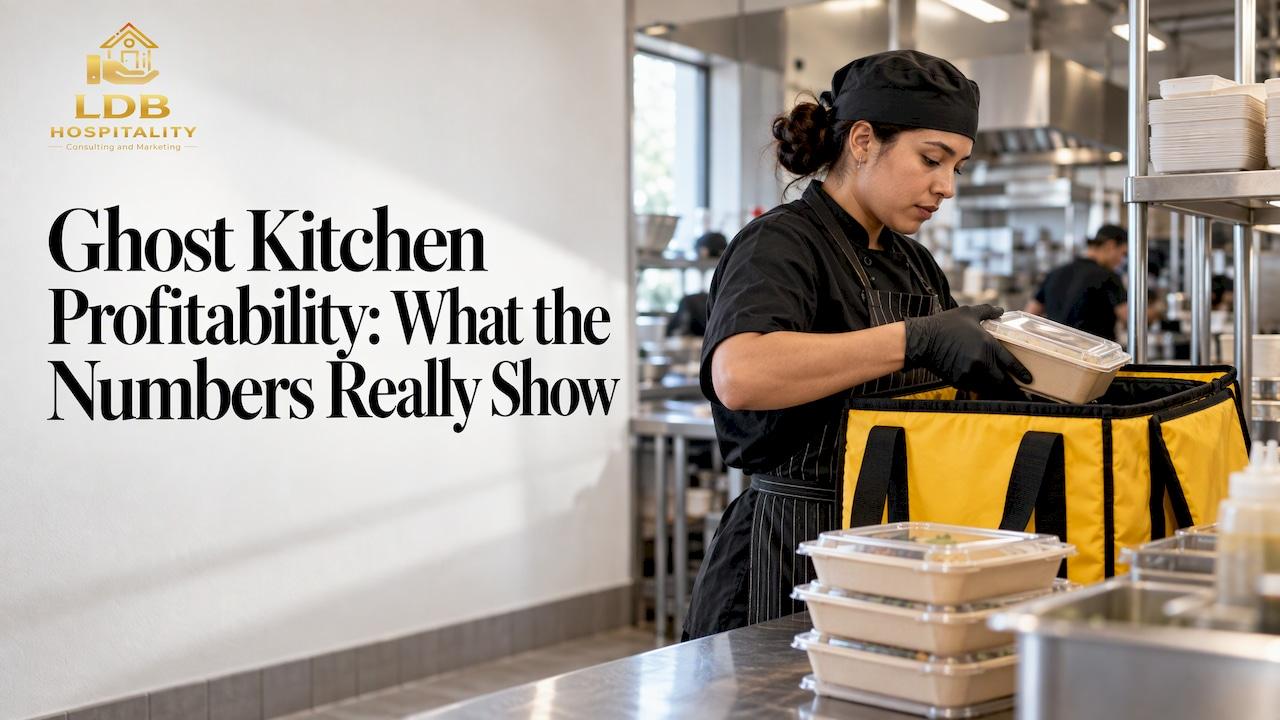
A ghost kitchen can be more profitable than a dine-in restaurant, but only when contribution per order, not headline sales, drives every decision. The reason is simple arithmetic: a $30 order with a 30% platform fee leaves $21 before you pay for food, labor, packaging or rent. Operators who treat the delivery-only restaurant model as a volume game lose money. Operators who manage order value, channel mix and cost per order keep the margin. At LDB Hospitality, our marketing strategy and guest reputation management services are built for exactly that second group.
TL;DR
- Ghost kitchens trade a dining room for delivery fees. Platform commissions, not rent, are usually the biggest line after food.
- Published target ranges put food cost at 28–35% of revenue, labor at 25–35%, and net margin at 5–15%.
- Break-even is monthly fixed costs divided by contribution per order. Small changes in commission or ticket size move it by several orders a day.
- The strongest strategy shifts orders to channels you own, keeps the menu tight and adds higher-ticket revenue such as catering.
- Reputation and marketing decide whether you can earn orders without paying for every one of them.
Table of Contents
- How the delivery-only model makes money
- The models and what each costs to start
- Per-order economics: where the margin goes
- Break-even: the number to know before you launch
- Average order value decides whether the model works
- A ghost kitchen strategy that protects margin
- What margins to plan for
- Our perspective
- Work with LDB Hospitality on your delivery numbers
- FAQ
- Sources
How the delivery-only model makes money
A ghost kitchen is a commercial kitchen that prepares food for delivery only. There is no storefront, dining area or front-of-house staff, and the menu lives on delivery apps or the operator's own ordering site. Some are dedicated kitchens, some are shared commissary stations, and some are virtual brands run out of an existing restaurant's kitchen. The Markup documented a pizza brand listed on a delivery app that was actually cooked in a family entertainment center's kitchen, which shows how little the guest sees of the operation.
The appeal is real. You skip dining-room rent, furniture and front-of-house payroll, and many operators locate in industrial areas to avoid downtown rents. What replaces those costs is a new one: the fee every delivery platform charges to put your food in front of customers. Profitability is the contest between the costs you removed and the fee you added.
The models and what each costs to start
The business model you pick sets your startup cost, your control and your ceiling. Published U.S. figures vary by source, so treat them as planning ranges and confirm them against local quotes.
| Model | What it is | Typical startup range reported |
|---|---|---|
| Shared commissary station | Rent a station in a turnkey kitchen by the hour or month | $20,000–$50,000 all-in |
| Dedicated leased kitchen | Your own delivery-only unit with full fit-out | $75,000–$150,000 |
| Virtual brand in an existing kitchen | A new delivery concept using idle capacity | Lowest, because there is no new space to lease |
| Branded pod | A prefabricated unit staffed under the brand | Pods start around $100,000 |
On rent alone, one 2026 U.S. analysis puts a dedicated delivery-only unit at $2,000–$10,000 a month and shared commissaries at $100–$1,250 a month or $15–$75 an hour. Permits add to the total: there is no federal ghost kitchen license, but you need a local business license, a state seller's permit, a health department food-service permit and a Food Protection Manager certificate. Requirements differ by city and state, so check with your local health department before you sign a lease.
For an existing restaurant owner, the virtual brand route is often the cheapest test. For an investor, a dedicated unit or multi-brand kitchen offers more control but needs real volume. Either way, the startup number matters less than the monthly math below.
Per-order economics: where the margin goes
The cleanest way to understand ghost kitchen profitability is to follow one order. Take a $30 ticket with 30% food cost. A per-order breakdown shows a 30% marketplace commission leaves $11.00 before labor and rent, while the same order placed on the operator's own page with a courier leaves $15.69, and as pickup $18.83.

That gap of roughly $4.69 per order, between a marketplace order and an own-channel delivery, is the single biggest profit lever in the model. It compounds with volume. On 600 orders a month it is about $2,800 of extra contribution, before you improve anything else.
A smaller example shows the same thing from the ingredient side. A $20 order with $6 of ingredients, a 20% channel fee, $1 of packaging and $0.50 of other variable costs keeps $8.50 as contribution. At a 25% fee, contribution drops to $7.50, and the orders needed to cover $17,000 of fixed commitments rise from 2,000 to 2,267. One five-point fee change added more than 260 orders a month to the break-even target.
The cost lines to watch

Published target ranges for a delivery-only operation are consistent across sources. Food cost 28–35% of revenue, labor 25–35%, platform fees 15–30%, rent and utilities 8–15%, net margin 5–15%. Those ranges overlap in a way that explains why many operators struggle: food, labor and fees at the high end of each range add up to well over 100%.
Three of those lines are fully in your hands:
- Food cost. Calculate it on net revenue, after commissions, not on gross sales. Our guide to food cost percentage shows how to calculate it and control it.
- Labor. Delivery kitchens need fewer people, but peak-hour scheduling still decides whether labor stays in range. See our labor cost control guide.
- Prime cost. Food plus labor is the number that predicts whether anything is left. Our prime cost benchmarks explain how to lower it.
The fourth line, the platform fee, is the one most founders underestimate. In one 60-orders-a-day model, delivery apps collect roughly three times what the landlord does, $162,000 against $54,000 a year. Operators negotiate rent hard and accept commissions without a fight. That is backward.
Break-even: the number to know before you launch
Break-even is monthly fixed costs divided by net contribution per order, where contribution is what an order earns after food, packaging, commission and other variable costs. Say your fixed costs are $15,000 a month and contribution is $11.10 per order. You need about 1,352 orders a month, roughly 45 a day or $40,500 in monthly sales.
The same source shows how sensitive that figure is:
- Moving from a 25% to a 15% commission plan raises contribution to $14.10 and cuts break-even to about 35 orders a day.
- Raising the average ticket from $30 to $34 cuts break-even to about 40 orders a day.
- Cutting fixed costs by $1,000 a month lowers break-even by about 3 orders a day.
In that same model, net results were a loss of $42,000 at 30 orders a day, a profit of $36,000 at 60, and a profit of $130,000 at 100. Treat these as one illustrative scenario with stated assumptions, not a forecast. The lesson is the shape: below break-even the losses are steep, and above it profit grows fast.
Another data point is worth knowing for investors. A 2020 study cited in testimony to the first U.S. hearing on ghost kitchens found an operator needed at least $650,000 in annual sales to break even. That is a high bar for a single brand with one channel.
What to expect on timing
Kitchens rarely hit stable volume on day one. One planning guide advises a 90-day cash runway, since kitchens can take two to three months to reach consistent volume. Add payout lag between the platform paying you and your suppliers expecting payment, and a kitchen with healthy margins can still run short of cash. Build that gap into your opening budget.
Average order value decides whether the model works
Commissions are a percentage, so a low ticket does not just shrink revenue, it squeezes everything else. Packaging, labor and the courier handoff cost about the same on a $15 order as on a $40 order. That is why ghost kitchens chase larger baskets.
Three practical moves raise average order value without discounting:
- Build bundles. A main, a side and a drink priced together lifts the ticket and simplifies prep.
- Price for the channel. Menu prices on delivery apps can be set above in-house prices to absorb the fee. Our menu pricing strategy guide covers how to price for profit and guest value.
- Add group and catering formats. A $400 catering tray carries the same unit fee as a $25 lunch, so large orders do more for your margin than anything else you can add.
For group orders and private events, restaurant buyouts show how a single high-ticket booking can be priced and contracted, which is a useful model for a delivery kitchen building catering revenue.
A ghost kitchen strategy that protects margin
The operators who stay profitable follow a consistent pattern, and it has little to do with finding a cheaper landlord.
Keep the menu tight
A short menu cuts waste, speeds the line and shrinks inventory. Fewer SKUs make it easier to hold food cost in range, and our guide to restaurant inventory management shows how to keep stock under control. A tight menu also makes kitchen workflow simpler to design for the peak hour, which is the real capacity limit in a delivery kitchen. Our piece on kitchen efficiency covers how to run a faster, leaner line.
Pull orders onto channels you own
The math on commissions is blunt. At a 25% commission, a well-run kitchen holds a 5–7% margin on a delivery order, and at 30% that falls to 0–2%, according to a margin analysis that source cites. Orders from your own site, phone line or repeat-customer list keep the full ticket. The marketplace brings first-time customers; your job is to convert them into direct ones.
That is a marketing problem, not a kitchen problem. It takes a defined audience, a reason to reorder and a brand guests recognize. One source puts platform fees at 20–25 cents of every revenue dollar for operators relying on a single platform with no direct ordering channel.
Earn the review before the order
A delivery-only brand has no dining room to win people over. Its entire reputation is a star rating, a few photos and written reviews. A rating slip changes your ranking on the app, which changes your order count, which changes your break-even position. Managing feedback and responding to complaints quickly is part of operating cost control, not a side task.
Run it on contribution, not sales
Track contribution per order and per peak hour weekly, not monthly revenue. Revenue can rise while contribution falls if a new promotion, a higher commission tier or a cheaper-looking bundle quietly erodes the margin. Revenue strategy matters here too, and our restaurant revenue management guide explains how to price and sell for yield. For the broader expense picture, see our restaurant cost control guide.
What margins to plan for
Published net margin figures for ghost kitchens differ widely by source and by what is counted. One 2026 report puts U.S. cloud kitchens at 8–15% net, with a well-run single location at about 2,000 orders a month and a $30 average ticket netting around $7,200 on $60,000 of revenue. GoFoodService's planning range is 5–15%.
Use the lower half of any range for your base case. Margins at the top assume tight control of every line above, a strong share of direct orders and a high average ticket. Your forecast should survive a commission increase, a slow first quarter and a food cost that runs two points over plan.
Our perspective
Most ghost kitchen plans we would want to review start with a revenue goal and work backward. We think the order should be reversed. Start with what one order earns after every variable cost, decide what you can control about that number, and only then ask how many orders you need.
The controllable parts are not mysterious. They are the menu, the price on each channel, how many guests come back directly, and what guests say about you online. That is why our approach combines data-driven market analysis, customer feedback evaluation and performance optimization with tailored marketing and reputation work for each client.
A delivery-only brand is built entirely out of marketing and reputation. When those are strong, you pay less for each order you win. When they are weak, you buy every order from a platform, and the margin goes with it.
La’Quentin
Work with LDB Hospitality on your delivery numbers
If you own a restaurant, a hotel kitchen or a hospitality investment and want to lift profitability, our Hospitality Marketing Strategies service builds customized strategies from market trends and customer feedback, and our Hospitality Guest Reputation Management service focuses on the ratings and reviews that drive repeat business. We work as a fee-for-service consulting partner tailored to your operation. To talk through your own numbers, book a consultation.

FAQ
Are ghost kitchens actually profitable?
They can be. Published net margin ranges run from about 5% to 15%, depending on the source and the model. Results depend on commission rate, average order value, food and labor cost, and whether you reach break-even volume, which one 2026 model puts at about 45 orders a day under its assumptions.
How much does it cost to start a ghost kitchen in the U.S.?
Reported ranges differ by model. A shared commissary station is often cited at $20,000–$50,000 all-in, and a dedicated leased kitchen at $75,000–$150,000. Permits, equipment and working capital are part of those totals, so get local quotes before you commit.
What is the biggest threat to ghost kitchen margins?
Delivery platform commissions. Typical fees run 15–30% per order, and moving from a 25% to a 30% tier can erase most of a well-run kitchen's margin on that order. Building a direct ordering channel and raising the average ticket are the most effective answers.
Do I need a license to run a delivery-only restaurant?
There is no federal ghost kitchen license. Operators generally need a local business license, a health department food-service permit and a Food Protection Manager certificate, along with a state seller's permit, according to a 2026 U.S. startup guide. Rules vary by city and state, so confirm requirements with your local health department.
Sources
- Ghost Kitchens vs. Virtual Restaurants
- What's a ghost kitchen? A food industry expert explains
- What Are Ghost Kitchens? The Markup
- Ghost Kitchen Business Plan: Costs, Licensing and How to Start
- Finding the ghost kitchen model that's right for your business
- How Much Do Ghost Kitchens Cost to Rent?
- How to Start a Ghost Kitchen
- How to Open a Ghost Kitchen
- Ghost Kitchen Cost: Startup, Monthly and Per Order
- Ghost Kitchen Economics: Contribution per Order
- Testimony for the Nation's First Hearing on Ghost Kitchens
- How to Write a Ghost Kitchen Business Plan
- Profitable Ghost Restaurants: Where the Margin Really Comes From
- Cloud Kitchen Profit: Margins, Costs and Earnings (2026)