
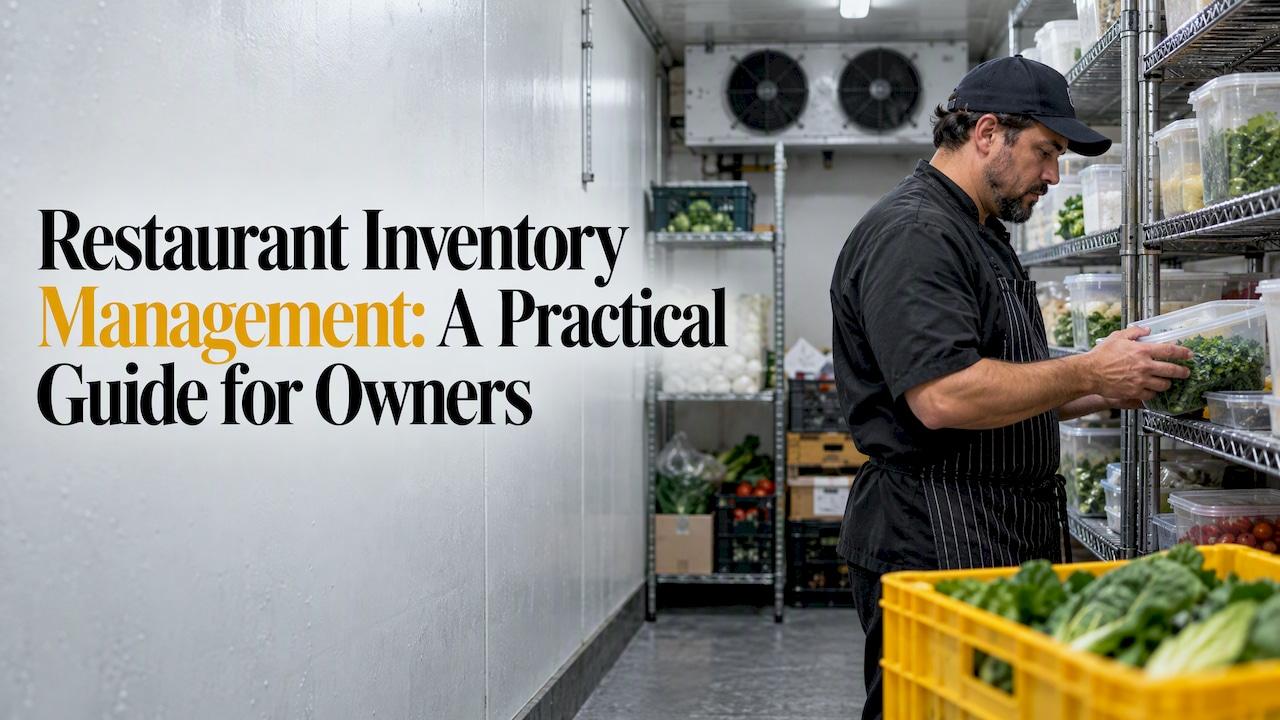
Restaurant inventory management means tracking what you buy, store, prep, waste and sell, so you know what you spent on food against what you earned. Done well, it protects your margin. It is also a cash discipline: every case of ribeye on a shelf is money you have already spent. This guide covers the counting routine, par levels, variance, waste and the tools that fit each stage of a restaurant.
TL;DR
- Count on a fixed schedule, weekly at minimum, and count high-value items (proteins, spirits) more often than dry goods.
- Set par levels from delivery frequency and real usage, then revisit them with the seasons.
- Compare theoretical usage (from recipes and sales) with actual usage. The gap is where waste, over-portioning and theft show up.
- Log waste at the moment it happens, and present it to staff as a data input, not a punishment.
- Roll out changes one step at a time. Software helps, but process and habits come first.
Table of Contents
- Why inventory is a cash problem before it is a waste problem
- What you are actually counting
- A counting routine that holds up
- Setting par levels that make sense
- Variance: the number that tells you something is wrong
- Build a waste log people will actually use
- Paper, spreadsheet or software
- Where we see operators go wrong
- Using inventory data to price and plan the menu
- A 30-day rollout plan
- When to bring in outside help
- FAQ
- Sources
Why inventory is a cash problem before it is a waste problem
Most advice frames inventory control as a way to throw less food away. That matters, but the bigger picture is money. The National Restaurant Association reports that food costs run 28% to 35% of restaurant sales, and average food costs and wages have climbed by at least 30% since 2019. When a third of every sales dollar goes to ingredients, small leaks add up fast.
The same source estimates that every $1 invested in food waste reduction can return roughly $8 in savings, and that tracking waste can trim food costs by 2% to 6%. Treat those as industry estimates, not promises for your kitchen. But even the low end is meaningful: on $1,000,000 in annual sales at a 32% food cost, a 2-point improvement is $20,000 a year.
Thinking in cash terms changes behavior. Overstocking ties up working capital in perishables. Understocking means 86'd dishes and lost sales. Good inventory management sits between the two.
What you are actually counting
Before you build a routine, decide what belongs on the count sheet. Food service inventory is usually split into four types: raw materials, work in progress, finished goods, and maintenance, repair and operations (MRO) items.
| Category | Restaurant example | Why it matters |
|---|---|---|
| Raw materials | Meat, produce, dairy, liquor | The bulk of your cost of goods |
| Work in progress | Prepped sauces, dough, marinated proteins | Easy to overproduce and discard |
| Finished goods | Plated-ready desserts, bottled items | Often forgotten on the count |
| MRO | Cleaning supplies, gloves, to-go packaging | Small per item, steady drain overall |
Many operators count only raw ingredients and treat prep as invisible. That hides waste: a batch of hollandaise made too early and tossed never shows up as a purchase problem. Give prepped items their own lines.
A counting routine that holds up
The mechanics are simple. The basic procedure in food service management texts is to know what is on hand so you can plan orders and calculate food cost for the period since the last count. The formula is:
Cost of goods used = beginning inventory + purchases − ending inventory
Divide that by food sales for the same period and you have your actual food cost percentage. For example, with $8,000 in beginning inventory, $14,000 in purchases and $7,500 in ending inventory, you used $14,500. On $46,000 in food sales, that is a 31.5% food cost.
Practical rules for counting
- Count on the same day and time every period. Close of business on the same weekday keeps periods comparable.
- Arrange the sheet in storage order. Walk-in left to right, shelf by shelf, so no one backtracks or skips a shelf.
- Use the same unit every time. Pounds, cases or each, but not a mix. Decide once whether a half-full bag counts as 0.5.
- Have one person count and another record, or rotate counters. A fresh set of eyes catches errors.
- Treat the count like a financial audit. It is not a chore to rush through before close.
Count high-value items more often
The 80/20 principle applies: roughly 80% of revenue tends to come from 20% of stock items, and those items deserve the tightest controls because a stockout or over-order there costs the most. In practice, that means spot-checking steaks, seafood and top-shelf spirits daily or several times a week, while a full count of dry goods can stay weekly or monthly.
Setting par levels that make sense
A par level is the quantity you want on hand after a delivery arrives, or before the next one. The core of par levels is delivery frequency and usage between drops. Toast's guide to par inventory describes the same logic: look at how often an item is delivered, work out how much you deplete between deliveries, and add a modest buffer.
Here is a worked example:
- Fries are delivered every Tuesday.
- You use about 6 cases from Tuesday to the next Tuesday.
- You add a buffer of one case for a busy weekend.
- Par is 7 cases. If 2 cases are on hand Monday night, you order 5.
Par levels are not permanent
Pars should move with the calendar: day of week, holidays, patio season, local events, a slow January. The National Restaurant Association suggests using historic sales data plus upcoming factors such as annual events or slower seasons to improve production planning. Review pars at least quarterly, and any time you change the menu.
Separate ordering from procurement
Many kitchens blur two jobs. Ordering is the supervisory task of keeping stock at par. Procurement is the management task of choosing vendors and negotiating prices. A food service management text draws this distinction. When one person does both without clear rules, par levels drift and vendor pricing goes unchallenged. Decide who owns each and write it down.
Variance: the number that tells you something is wrong
Actual food cost alone tells you little. The useful comparison is theoretical versus actual. Theoretical usage is what your recipes and sales say you should have consumed. Actual usage is what the count says you did consume.
If you sold 300 burgers at 6 ounces of beef each, theoretical usage is 112.5 pounds. If the count shows 128 pounds gone, you have a 15.5 pound gap. That gap could be:
- Portion creep: cooks building heavier plates than the spec
- Unrecorded waste, such as dropped product or trim
- Over-ordering that spoiled
- A vendor shorting a delivery or an invoice error
- Theft
Variance does not tell you which one. It tells you where to look. Check high-cost items first, since a 5% variance on tenderloin matters far more than 5% on lettuce.
The habit that separates strong operators is catching variance weekly instead of at month end. By then a month of losses has compounded and no one remembers the Friday that went sideways.

Build a waste log people will actually use
Waste data is only useful if it is recorded when it happens. If a cook finds spoiled product during prep and says nothing, your numbers are wrong and your reorders will be too.
The culture piece matters as much as the sheet. The National Restaurant Association advises pitching procedural changes as management efficiency tools rather than waste reduction initiatives to win staff buy-in, and rolling out incremental changes to standard operating procedures instead of one overhaul.
A simple log needs five columns: date, item, quantity, reason (spoiled, overcooked, dropped, returned, expired) and initials. Review it weekly with your kitchen manager. If the same item shows up three weeks running, change the par, the prep quantity or the menu.

Paper, spreadsheet or software
The right tool depends on size and complexity.
| Setup | Best for | Limits |
|---|---|---|
| Clipboard or printed count sheet | One small location with a short menu | Slow math, little reporting |
| Spreadsheet | Owners comfortable with formulas | Manual entry, version errors, no live link to sales |
| Cloud inventory software | Multiple menus, busy kitchens, multiple units | Setup time, needs clean recipe data |
The National Restaurant Association notes that inventory systems automate time-consuming procedures and should provide detailed reporting on cost of goods sold, waste tracking and usage trends. Look for a system that connects to your point of sale, so sales deplete ingredients through recipes automatically, and that reconciles theoretical against actual usage.
A caution: software does not fix a weak process. If recipes are not costed, counts are inconsistent and waste goes unlogged, the dashboard just displays bad data faster. Get the routine right on paper first, then automate it.
Where we see operators go wrong
Inventory is where operational discipline and profitability meet. Many of the restaurants and hotel F&B outlets we look at do not have a food cost problem, they have a measurement problem. Counts happen irregularly, recipes are out of date, and nobody owns the variance number. We approach this the way we approach everything: start with the data, understand what the market and guest feedback say about the menu, then build a plan around the operation as it really runs. A tighter inventory process is rarely about squeezing suppliers or cutting portions. It is about knowing which items drive your revenue, protecting those, and giving your team a simple system they trust. When the numbers are reliable, pricing, menu engineering and marketing decisions get much easier.
— La’Quentin
Using inventory data to price and plan the menu
Good counts feed decisions beyond ordering. The National Restaurant Association's pricing guidance says you need to know your true costs before you can price strategically. Accurate costing from inventory tells you which dishes earn their place and which quietly lose money when ingredient prices jump.
Three uses to start with:
- Re-cost your top 10 sellers whenever a major ingredient price moves.
- Plan specials around what you already hold, especially items close to their use-by date.
- Cut slow movers that require unique ingredients used nowhere else on the menu.
A 30-day rollout plan
Do not change everything at once. Try this sequence:
- Week 1: Build the count sheet in storage order, with units and current prices. Do one full count.
- Week 2: Repeat the count, calculate cost of goods used and actual food cost. Start the waste log.
- Week 3: Set initial pars for your top 20% of items by revenue. Spot-check proteins and spirits midweek.
- Week 4: Compare theoretical and actual usage on your top five costliest items. Investigate the biggest gap and assign an owner.
After 30 days you have a baseline, which is the thing you were missing. Then decide whether software is worth it.
When to bring in outside help
If your variance stays high after a few cycles, your food cost is rising despite price increases, or you manage several outlets with inconsistent routines, an outside operational review can save time. We work with hotel and restaurant owners and hospitality investors on strategic consulting, operational support and performance optimization, using market and customer feedback data to shape plans around your property. If you want to talk through your numbers, book a consultation, or see how our hospitality marketing strategies support the revenue side of the same picture.
FAQ
How often should a restaurant count inventory?
Weekly is a sound minimum for most restaurants, on the same day and time. High-value items such as steaks, seafood and premium spirits are worth spot-checking more often, while shelf-stable goods can be counted less frequently.
What is a par level in a restaurant?
A par level is the target quantity of an item you want on hand after a delivery or before the next one. You set it from delivery frequency and usage between deliveries, plus a small buffer, and adjust it for seasons, events and menu changes.
What is a good food cost percentage?
The National Restaurant Association reports that food costs typically run 28% to 35% of sales. Your target depends on concept, menu pricing and service style, so compare against your own trend and your menu's theoretical cost.
Do small restaurants need inventory software?
Not always. A single location with a short menu can run well on count sheets and a spreadsheet. Software pays off when your menu is large, you run several locations, or you want recipe-level variance reporting tied to your point of sale.
What is the 80/20 rule in restaurant inventory?
It holds that about 80% of revenue comes from roughly 20% of items. Focus your tightest controls on those items, because mistakes there cost the most in lost sales or waste.
Sources
- Working to reduce food waste, National Restaurant Association
- Restaurateurs use tech to manage inventory, save money, National Restaurant Association
- 5 restaurant experts dish on menu pricing strategy, National Restaurant Association
- Chapter 10: Managing Inventory Control and Procurement, Introduction to Food Production and Service
- What are the four types of inventory management for restaurants?
- Hospitality Inventory Management Guide, Paddl
- How to Set Up a Par Inventory Sheet, Toast