
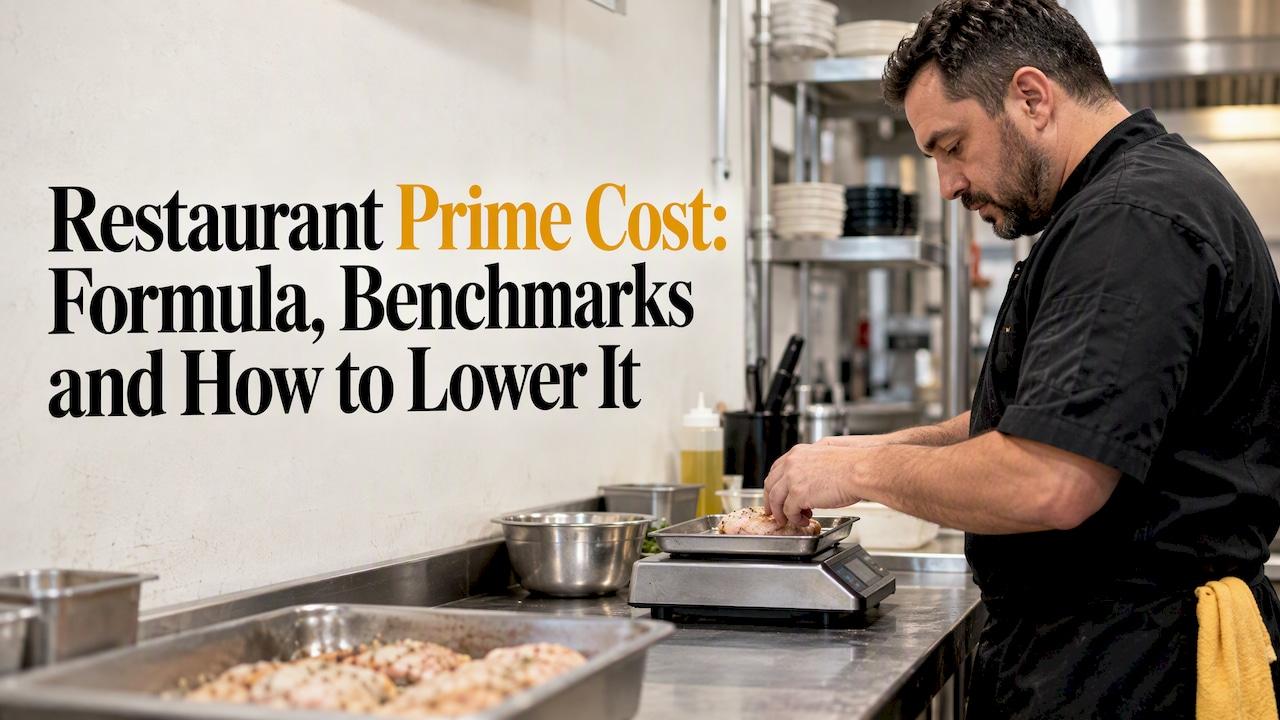
Restaurant prime cost is your cost of goods sold (COGS) plus your total labor cost, usually expressed as a percentage of sales. Most US operators aim to keep it somewhere between 60% and 65% of sales. Above roughly 65% to 68%, there is very little left for rent, debt service or your own paycheck. This guide shows you how to calculate it, what a good number looks like for your concept, and how to bring it down without gutting your food or your team.
TL;DR
- Prime cost = COGS (food, beverage, packaging) + total labor (wages, payroll taxes, benefits, insurance), divided by total sales.
- National Restaurant Association data points to a typical range of 60% to 65% of sales. Limited-service concepts often aim for 60% or lower.
- A prime cost above about 65% to 68% leaves little room for fixed costs, debt and profit.
- Track it weekly, not monthly, and look at labor per shift, not just labor percentage.
- The fix is usually in three places: purchasing and waste, menu mix and pricing, and scheduling against real demand.
Table of Contents
- What prime cost means in a restaurant
- The prime cost formula
- What prime cost should be
- Prime cost versus COGS, and the 30-30-30 rule
- Why a monthly number is too late
- How to lower prime cost
- What to do when prime cost is still too high
- Our perspective
- Getting help with your numbers
- FAQ
- Sources
What prime cost means in a restaurant
Prime cost is the combination of your two largest expenses, and they are also the two you can change fastest. Rent and utilities are fixed for the term of a lease or contract. Food purchases, portions, scheduling and overtime change every week, based on decisions you and your managers make.
That is why operators treat it as a health check. Sage describes the two components as COGS, which covers ingredients and related materials such as disposable food containers, and labor. Toast's guide adds that COGS includes food, alcohol, beverages and packaging, while labor covers wages, payroll taxes, benefits and insurance.
Two details trip people up:
- Labor is more than the hourly wage. If you leave out payroll taxes, workers' compensation and benefits, your number will look better than it is.
- Salaried managers count. Whether to include them is a choice, but you must be consistent. If you compare your number to a benchmark that includes management and yours does not, the comparison is meaningless.
The prime cost formula
The formula is straightforward:
(COGS + total labor) ÷ total sales × 100 = prime cost %
This is the version Toast publishes. Pick a period, a week or a four-week accounting period, and use the same period for every input.
COGS the right way
COGS is not what you spent on food invoices. It is what you actually used:
Beginning inventory + purchases − ending inventory = COGS
If you skip the inventory count and use invoices alone, a big delivery on Friday will make that week look terrible and the next one look great. Count at the same time each period, ideally right after close on the same weekday.
A worked example
The numbers below are illustrative, not benchmarks for your restaurant.
| Line | Amount |
|---|---|
| Weekly sales | $48,000 |
| Beginning inventory | $9,000 |
| Purchases | $15,500 |
| Ending inventory | $8,700 |
| COGS | $15,800 (32.9% of sales) |
| Hourly wages | $12,400 |
| Manager salaries | $2,600 |
| Payroll taxes, workers' comp and benefits | $3,400 |
| Total labor | $18,400 (38.3% of sales) |
| Prime cost | $34,200 |
Prime cost % = $34,200 ÷ $48,000 = 71.3%.
That restaurant is busy and still in trouble. Neither line looks catastrophic alone, but together they sit well above the 65% to 68% zone where experts say net profitability comes under severe pressure. To reach 65% on the same sales, the restaurant needs to find about $3,000 per week.
What prime cost should be
There is no single correct number. The figures that circulate come from different surveys, different restaurant types and different definitions, so treat them as a corridor.
| Segment | Typical prime cost target | Source context |
|---|---|---|
| Full-service | 60% to 65% of sales | National Restaurant Association data for 2025 |
| Limited-service | 60% or lower to stay competitive | Same NRA data |
| Danger zone | Above about 65% to 68% | Industry finance experts |
The NRA release also reports a median full-service labor cost of 36.5% of sales. If labor alone is that high, you can see why the food side has little slack.
For the components, Apicbase's roundup of industry statistics lists target COGS of 28% to 35% and labor of 25% to 35% for most US restaurants, with fine dining at the higher end because service is so labor intensive.
Why your target depends on your concept
- Fine dining carries more labor per cover and more expensive proteins. A prime cost at the upper end of the range can be sustainable if check averages are high and rent is manageable.
- Quick-service and fast-casual have simpler menus and fewer people per transaction, so a lower number is realistic. Sales volume matters most here: a slow day means the same crew serves fewer guests.
- Bars and beverage-led concepts often have lower COGS percentages, which can allow higher labor. Look at your own blended number, not a food-only benchmark.
- Ghost kitchens and delivery-heavy models add packaging to COGS and may have third-party commissions elsewhere. Make sure those fees sit in the right line so prime cost is not distorted.
A better target than a generic one is your own: take your prior-year numbers, pick the three best weeks and ask what was different.
Prime cost versus COGS, and the 30-30-30 rule
People ask about the difference between prime cost and COGS. COGS is only the product cost of what you sold. Prime cost is COGS plus labor. Your COGS can look perfect while prime cost is in trouble because labor is bloated.
The "30-30-30" rule, meaning 30% food, 30% labor and 30% overhead with 10% left as profit, is a tidy teaching device. According to Apicbase's summary of expert commentary, it is increasingly unrealistic now that labor and food costs have risen by more than 30% since 2019. Their suggested approach is prime cost balancing: if food runs at 35%, labor has to land closer to 20%, or the reverse, so that the total stays under your ceiling.

That is a useful way to think, but be honest about what it implies. Labor at 20% is hard in a full-service dining room. If your food cost is structurally high because of your concept, the realistic lever might be menu price and mix rather than cutting staff.
Why a monthly number is too late
A monthly profit and loss statement tells you what happened three or four weeks ago. By then, the overstaffed Tuesdays and the over-ordered produce have already happened a dozen times.
Track a weekly prime cost, and split it into its parts:
- COGS % by category: food, liquor, beer, wine, N/A beverage, packaging.
- Labor % by department: front of house, back of house, management.
- Labor dollars per shift compared against a budget and the same weekday last week.
That last one matters. Labor percentage on its own can mislead when volume is low: a quiet night makes the percentage jump even if you scheduled correctly. A finance team's guide recommends comparing labor cost per shift with a budget or the prior week's volume to catch hidden overstaffing. A Tuesday lunch that suddenly costs more often traces to an unnecessary prep shift, a double-booked position, or a manager who staffs up to avoid conflict. None of that shows on a monthly summary.
How to lower prime cost
Work the list in this order. The first items are usually the cheapest to fix.
1. Measure inventory properly
If you do not count, you do not know your COGS. Weekly counts for high-cost items (proteins, liquor, seafood) and monthly counts for dry goods is a workable rhythm. Compare actual usage with theoretical usage from your point-of-sale item sales. A gap points to waste, over-portioning, theft or unrecorded comps.
2. Fix the recipe costs and portions
Cost every menu item from current invoices, not last year's. Weigh portions at the station for a week. A one-ounce drift on a high-cost protein across hundreds of covers is real money.
3. Engineer the menu
Sort items by popularity and margin. Promote the items guests like that also make money, reprice or reposition the popular low-margin ones, and cut the items that are both unpopular and expensive to make. Often the cheapest improvement is a small price move on a dish nobody shops on price.
4. Tighten purchasing
Check how many vendors you use and whether you are paying for convenience you do not need. Set par levels based on actual usage. Order to the forecast, and receive deliveries against invoices so you are not paying for short weights.
5. Schedule to demand
Build the schedule from sales forecasts by daypart, not from habit. Check where you carry two people doing one job. Stagger start times, cut the first hour of closing cleanup crews when it is not needed, and cross-train so one person can cover two stations in a slow period. Watch overtime closely, because it is the most avoidable premium on your payroll.
6. Raise sales per labor hour
Prime cost is a ratio, so it improves when sales go up too. Fixed-ish labor, such as the minimum crew you need to open the doors, gets cheaper per dollar when the dining room fills. This is why marketing and prime cost are linked: a better Tuesday is a lower-percentage Tuesday.
7. Retain your people
Turnover costs money in recruiting, training and slower service. Stable teams are faster, make fewer errors and waste less food. This does not show up as a line item, but it flows into both halves of prime cost.
What to do when prime cost is still too high
If you have done the basics and the number does not move, the cause is usually structural. Ask:
- Is the menu too large for the kitchen's labor model?
- Are prices behind your actual costs? According to the National Restaurant Association's 2026 State of the Industry report, operators continue to grapple with rising costs on nearly every line item, so prices set two years ago may no longer fit.
- Is traffic the issue? Dampened customer traffic and stubbornly elevated costs together kept margins modest, according to the NRA's 2025 release. Cutting costs alone cannot fix a demand problem.
- Is the format wrong for the location? A concept that needs a full crew on a street with weak lunch trade will struggle whatever the scheduling discipline.
Sometimes the right answer is an outside view. A fresh set of eyes on your data can find patterns the team has stopped seeing.
Our perspective
We work with hotel and restaurant owners, and the pattern we see is that prime cost is treated as an accounting output when it should be a management tool. Owners look at it once a month, after the damage is done, and then react to the percentage instead of the cause.

Our approach is data-driven. We start with the numbers you already have: sales by daypart, labor by shift, recipe costs and what guests say in their feedback. Then we ask which levers fit your concept. For one restaurant that is purchasing and waste. For another it is a menu that asks too much of the line. For a third the real issue is that the dining room is empty on the shifts you are paying for, which is a marketing and guest-experience problem, not a cost problem.
Our advice, in plain terms: do not chase a benchmark for its own sake. Set a ceiling that your concept can actually hit, review it every week, and treat a single bad shift as a question to answer rather than a number to explain away. Lower costs that cost you guests are not savings.
— La’Quentin
Getting help with your numbers
If you own a hotel restaurant or an independent dining room and your prime cost has drifted, we can review your operation and the market around it. Our hospitality marketing strategies tie guest feedback and market trends to the shifts and menu items where you most need revenue. Start with a consultation, or see more about our hospitality services.
FAQ
What does prime cost mean in a restaurant?
It is the total of your cost of goods sold and your total labor cost, usually shown as a percentage of sales for a week or month. It covers your two largest controllable expenses. It is called "prime" because it largely decides whether you make money or just stay busy.
What should restaurant prime cost be?
National Restaurant Association data points to about 60% to 65% of sales, with limited-service concepts often at 60% or below. If you stay above roughly 65% to 68%, profit is under severe pressure. Your own target depends on your concept, your check average and your lease.
What is the difference between prime cost and COGS?
COGS covers only product costs: food, beverage and supplies. Prime cost adds all labor, including wages, payroll taxes, benefits and insurance. A restaurant can have strong COGS and still have a poor prime cost if labor is too high.
What is the 30-30-30 rule for restaurants?
It is a simple guideline of 30% food, 30% labor and 30% overhead, leaving about 10% for profit. Industry commentary says it is increasingly unrealistic given cost increases since 2019. Many operators now balance food and labor against a total prime cost ceiling instead.
Sources
- New resource from the National Restaurant Association provides insights into operational realities
- How to Calculate Prime Cost, Toast
- 63 Restaurant Industry Statistics & Trends for 2026, Apicbase
- The Financial Reports For Restaurant Owners That Should Be Tracked
- What every restaurant operator needs to know about prime cost, Sage
- State of the Restaurant Industry 2026, National Restaurant Association