
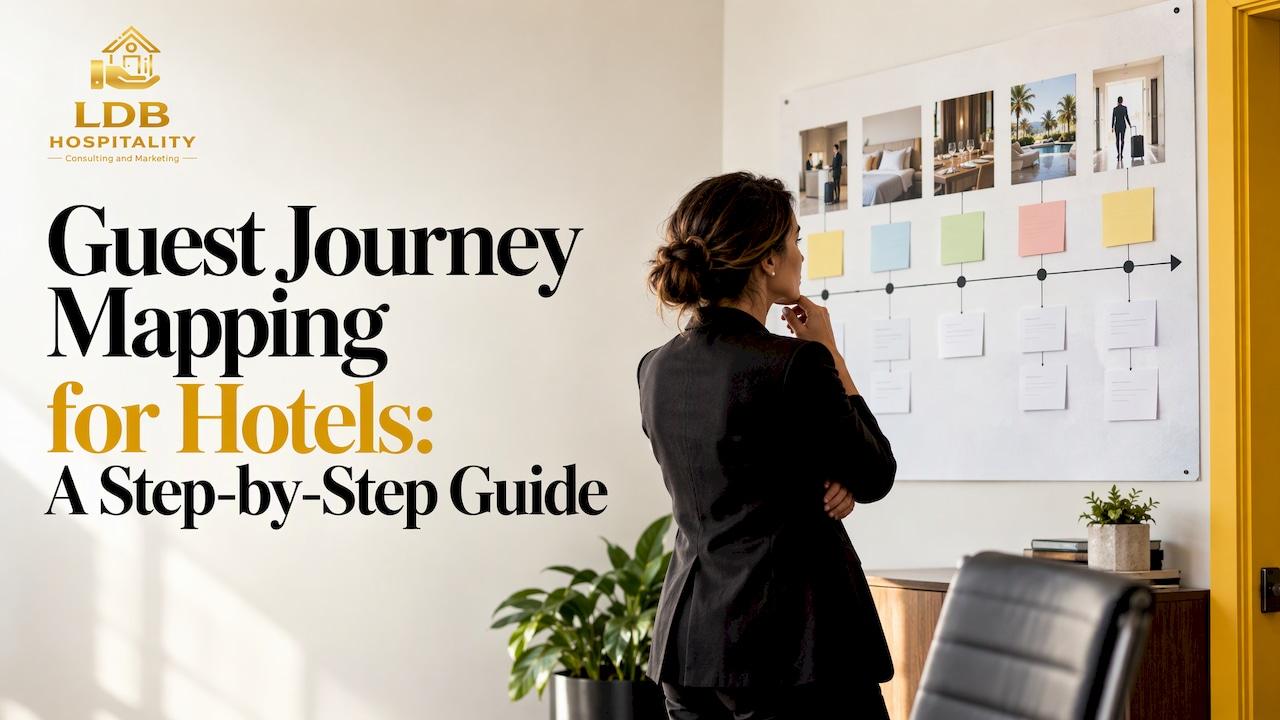
Guest journey mapping is the practice of laying out every step a guest takes with your property, from the first time they see your name to the review they write after checkout. Then you mark where the experience works, where it breaks, and who or what is responsible at each point. Done well, the map becomes a ranked list of fixes: the few moments that shape reviews, repeat stays and revenue, in the order you should tackle them. This guide shows you how to build one, what to put on it, and how to use it to make operating decisions.
TL;DR
- A hotel guest journey runs from inspiration to booking, pre-arrival, the stay and post-stay loyalty. Your map should cover all of it, not just the time the guest is in the building.
- Each stage needs three layers: what the guest does and feels, which touchpoint carries it, and which team, process or system sits behind it.
- Build the map in three passes: gather existing data, draft the map, then validate it with guests and staff.
- Spend your effort where perception is formed: arrival, service recovery and departure, and fix those before anything else.
- A map is a working document. Review it on a schedule, because guest expectations keep moving.
Table of Contents
- What guest journey mapping means in a hotel
- The stages of the hotel guest journey
- What to put on a guest journey map
- How to build the map, step by step
- Illustration: from map to action
- Connecting the map to revenue and profit
- Keep the map alive
- How we can help
- Our perspective
- FAQ
- Sources
What guest journey mapping means in a hotel
A hotel guest journey map is a visual representation of the steps guests take throughout their relationship with a hotel, as UXmatters describes it. In plain terms, it is a timeline with the guest's actions, expectations and emotions on one side and your people, processes and technology on the other.
Hospitality differs from a standard retail customer journey in a few ways that matter for how you draw it. EHL Hospitality Business School points out that a hotel journey has a gap between purchase and the stay, the possibility of cancellation after booking, and an occupancy stage that lasts at least two days and has a clear endpoint. A guest who books in March for a September stay is a customer for months before you ever see them, and what you send in that gap shapes how they arrive.
It also helps to know how travelers actually behave. Travel decisions are emotional and rarely follow a straight line. Expedia Group's partner team, in a discussion of its Path to Purchase study, describes the buyer journey as closer to concentric circles than a linear path: guests get inspired, consult family, search online travel sites and loop back. EHL says the same: people check rates, postpone a trip, or return to researching destinations. Your map is a simplification, so draw it as stages with loops, not as a one-way arrow.
If you run a hotel, this is the same tool whether you operate a 40-room independent or a resort with several outlets. Restaurant owners can use the same logic inside the property or as a standalone venue: reservation, arrival, seating, service, payment, follow-up.
The stages of the hotel guest journey
Sources slice the journey differently. EHL's research uses six stages. Others use five or seven. The labels matter less than covering every phase and owning each one. A practical version for a US hotel:
| Stage | What the guest is doing | Typical touchpoints | Who owns it |
|---|---|---|---|
| Inspiration and awareness | Dreaming, seeing options | Social posts, search and AI results, ads, word of mouth | Marketing |
| Consideration and planning | Comparing price, reviews, photos, location, amenities, cancellation terms | Your website, review sites, online travel sites | Marketing, revenue |
| Decision and booking | Choosing a rate and booking | Booking engine, phone, confirmation email | Revenue, reservations |
| Pre-arrival | Waiting, planning the trip, possibly cancelling | Pre-arrival messages, mobile check-in invite, upsell offers | Front office, guest relations |
| Occupancy | Arriving, checking in, using the room, eating, asking for help | Front desk, room, Wi-Fi, F&B, housekeeping | Operations |
| Post-stay and loyalty | Checking out, reviewing, deciding whether to return | Departure experience, survey, review responses, loyalty emails | Guest relations, marketing |
Why the early stages are changing
The top of the journey is shifting. Hospitality Net reports that 39% of active US travelers use AI for travel, while traditional search engine use fell from 52% in late 2024 to 36% in the second half of 2025. For your map, that means the "inspiration" and "research" rows should name the places guests actually form an impression of you, including AI-generated summaries, not just your own website.
EHL's guest experience guide adds that during research guests compare pricing, reviews, location, amenities, loyalty benefits, cancellation policies and photos across platforms. Each of those is a touchpoint you can audit.
Why reviews sit across the whole map
Reviews are both an output of the journey and an input to the next guest's. EHL reports that 81% of travelers always or frequently read reviews before booking, and that a one-point increase in review score has a direct effect on revenue and average daily rate. A failure at check-in becomes a lost booking three months later, which is why the map has to connect the stay to the top of the funnel. Our guide to hotel reputation management covers the review side in detail.
What to put on a guest journey map
A map that only lists touchpoints is a checklist. A useful one has layers.
1. The guest layer. For each stage, write what the guest is trying to do, what they expect, and how they likely feel. Expectations are the core: a peer-reviewed study of the hotel consumer journey applies expectation confirmation theory. Satisfaction arises when real experiences meet or exceed expectations, driving loyalty and positive word of mouth, while unmet expectations produce dissatisfaction and damaging reviews.
2. The touchpoint layer. List every point of contact. The HSMAI Hospitality Upgrade approach starts at the reservation and details every touchpoint forward: communications such as pre-arrival messages, signage, follow-up, surveys and review responses; contactless or mobile check-in and checkout; and the onsite experience, including in-room entertainment, Wi-Fi, food and beverage, and housekeeping.
3. The backstage layer. For each touchpoint, name the person, process and system that delivers it. HSMAI's recommendation is to map each touchpoint to its supporting technology, which exposes improvements in people, process and technology. This is the layer most hotels skip, and it is where operational fixes come from. A slow check-in is rarely a front desk attitude problem. It is usually a property management system, a key-encoding step or a missing pre-arrival form.
4. The pain point and delight layer. Mark friction points, neutral moments and moments of real delight. You want to protect the delights as much as repair the pain points.
5. The metric layer. Attach one measure to each stage so you can tell whether a change worked: booking conversion, pre-arrival response rate, check-in time, in-stay survey score, review score, repeat-stay rate.

A note on segments
Different guests walk different paths. A GBTA and Omni survey of 500 US business travelers in 2018 found that they consider three hotels before booking, 84% say a personalized experience is important, and 64% buy different amenities on business trips than on other trips. Treat that as a reason to build separate maps for your main segments (business, leisure, groups) rather than one average journey. Start with the segment that brings the most revenue. If corporate stays matter to your property, it helps to understand how companies book hotels for travelers, because the person who books is often not the person who stays.
How to build the map, step by step
The method below follows a three-phase approach described in a Gem Journal whitepaper: compile existing data, draft the map, then validate it with research. Below, each step shows what it takes and where it usually goes wrong.
Step 1: Choose one segment and one question
Pick a guest segment and a business question, such as "why do our weekend leisure guests rate arrival lower than their room?" A map with no question becomes a poster. Where it goes wrong: trying to map every guest type at once, which produces a vague average that helps nobody.
Step 2: Gather the data you already have
Collect satisfaction ratings, market research, review text, call logs, feedback forms, sales data and staff interviews. You probably already own most of it. Where it goes wrong: each source sits with a different department, and nobody reads them side by side. Evaluating customer feedback across sources and tying it to market data is part of the work we do for hotel and restaurant clients, and it is usually where the first surprises show up.
Step 3: Draft the stages and touchpoints
Put the stages across the top and fill in the layers from the previous section. Line up each touchpoint with the pain points, neutral interactions and moments of delight in your data. Keep the draft to one page. Where it goes wrong: writing the map from the owner's or manager's perspective, so it records what you intend to deliver, not what guests experience.
Step 4: Walk it as a guest
EHL's Emma Näpänkangas advises mapping the entire journey from the guest's perspective, walking each stage as the traveler would to find friction and delight. Book a room on your own site and through an online travel site. Read the confirmation email on a phone. Try mobile check-in. Call the hotel at 9 pm. Where it goes wrong: staff who know the building skip steps a first-time guest cannot, such as finding the side entrance or working the Wi-Fi login.
Step 5: Validate with guests and staff
Test the draft against reality with guest surveys, interviews and observation, and let the results confirm or overturn your assumptions. Interview front desk, housekeeping, reservations and F&B teams too: they know where guests get stuck and which workarounds are hiding a broken process. Where it goes wrong: validating only with happy guests who answered the survey, so the map never shows the people who quietly left.
Step 6: Rank the gaps
Score each pain point by how many guests it touches, how much it moves perception and how hard it is to fix. EHL advises investing disproportionately in the moments that shape perception most, such as arrival, service recovery and departure. It also warns against automating without strategic priority at the cost of human connection. Where it goes wrong: fixing what is cheap and visible (a new lobby scent) instead of what is costly to guests (a 25-minute check-in queue on Friday at 4 pm).
Step 7: Assign owners, fixes and measures
Every priority gets one owner, one change, one metric and one review date. Where it goes wrong: the map is approved in a workshop and nobody owns any of it. This is the step where outside management support pays off most: performance optimization, staff training and tracking results month by month are things our team does alongside owners, so the map turns into changes on the floor.
Illustration: from map to action
Here is a hypothetical example to show the logic, not a real client result. Imagine a 120-room hotel whose map shows high satisfaction with rooms but weak scores at arrival. The backstage layer reveals that pre-arrival emails carry no check-in link, so every guest queues at the desk at the same hour, and housekeeping releases rooms late in the afternoon.
The ranked fixes could be: send a mobile check-in invitation three days before arrival, align the room release schedule with the busiest arrival window, and train the desk team on a short recovery script for guests who wait. Each fix has an owner and a metric: check-in time, arrival survey score, and the share of reviews that mention waiting. Our guides to rolling out mobile check-in and to building hospitality training programs cover the two main levers in that example.

Connecting the map to revenue and profit
A journey map earns its place when it feeds decisions you already make.
- Marketing: the inspiration and research rows show where guests meet your brand and what they compare you on. That shapes channel and message choices, and it links to your market analysis.
- Revenue: the booking and pre-arrival rows show cancellation points and upsell moments, which feed revenue management and your push to increase occupancy.
- Technology spend: HSMAI's Caryl Helsel argues that hotels often make guest-experience choices on finance alone, and that defaulting to the cheapest option may not deliver the best experience. A journey map supports guest-centric, data-informed technology decisions, and because retention costs less than acquiring new guests, those decisions pay back over time.
- Reputation: the post-stay row ties survey and review response work to the moments that caused the comments.
- Operations and assets: backstage failures such as a broken lock or noisy HVAC show up as guest pain points, which is why upkeep belongs in the conversation. See our guide to preventive maintenance for hotels.
Helsel also argues that reviews alone only surface systemic problems, while a thorough and objective journey map goes further. That is the point for investors and owners: a map ties a score to a cause you can fix.
Keep the map alive
EHL cautions against making a journey map once and forgetting it. Guest expectations change constantly, and innovations of the early 2020s such as mobile keys and contactless check-in are the baseline in 2026. Audit the journey on a regular schedule, quarterly for the fast-moving stages (research, booking, arrival) and at least yearly for the full map, and compare it against what nearby properties offer. Re-run it after any major change: a new property management system, a renovation, a brand switch or a change in your guest mix.
How we can help
If you would rather have the map built, tested and turned into a prioritized plan alongside experienced hospitality specialists, that is what our consulting engagements are for. We combine data-driven market analysis, customer feedback evaluation and performance optimization for hotels and restaurants, with services including hospitality marketing strategies and guest reputation management.

To discuss your property, start with a consultation.
Our perspective
Most hotels we talk with do not lack data. They lack a single picture that puts guest feedback, market trends and operating reality on the same page. That is what a guest journey map should be.
Our method is data-driven: we use market trends and customer feedback to build strategies tailored to each property, aimed at better occupancy, retention and profitability. The journey map is the natural starting frame for that work, because it shows where guest experience and operations meet.
We believe the map is only as good as the follow-through. A strong map ends in specific changes: staff training matched to the moments that matter, marketing that reflects what guests actually value, and a reputation process that closes the loop after the stay.
Owners and investors should expect a map to answer one question: where will the next hour or dollar of effort improve guest satisfaction the most? That is the question we start every engagement with.
La’Quentin
FAQ
What are the stages of a guest's journey?
A common hotel version has six: inspiration and awareness, consideration and planning, decision and booking, pre-arrival, occupancy, and post-stay and loyalty. Some models use five or seven by splitting or merging stages. What matters is that every phase has an owner and a measure.
How is a hotel guest journey different from a general customer journey?
A hotel journey includes a long gap between booking and arrival, the chance of cancellation after booking, and an in-stay phase that lasts days. It is also highly emotional, since travelers are buying an experience. That is why the pre-arrival and occupancy stages need more detail than a typical retail map.
How do I validate a guest journey map?
Start with existing data such as reviews, survey scores and staff interviews to draft the map. Then test it with guest surveys, interviews and observation, and walk the journey yourself as a guest. Revise anything the evidence contradicts.
How often should I update the map?
Review the early stages quarterly and the full map at least once a year. Update it sooner after a renovation, a systems change or a shift in guest mix, since expectations keep rising.
Does journey mapping apply to restaurants?
Yes. The stages are shorter: discovery, reservation, arrival, ordering, service, payment and follow-up. The same layers apply: guest expectations, touchpoints, backstage processes and one metric per stage.
Sources
- How to Map the Hotel Customer Journey and Increase Bookings (EHL)
- Hotel Customer Journey: The Guest Experience Guide (EHL)
- Mapping the Hotel Guest Journey to Optimize the Customer Experience (UXmatters)
- Understanding Travel Behaviors and Path to Purchase (Expedia Group Partner Solutions)
- Hotel Customer Journey: The Guest Experience Guide (Hospitality Net)
- Mapping the consumer journey in the hotel industry (Consumer Behavior in Tourism and Hospitality)
- Guest Journey Mapping: From an IT and Commercial Strategy Perspective (HSMAI Hospitality Upgrade)
- Business Travelers Say Loyalty Matters in Hotel Booking (GBTA)
- Creating a Friction-Free Guest Experience (Gem Journal)