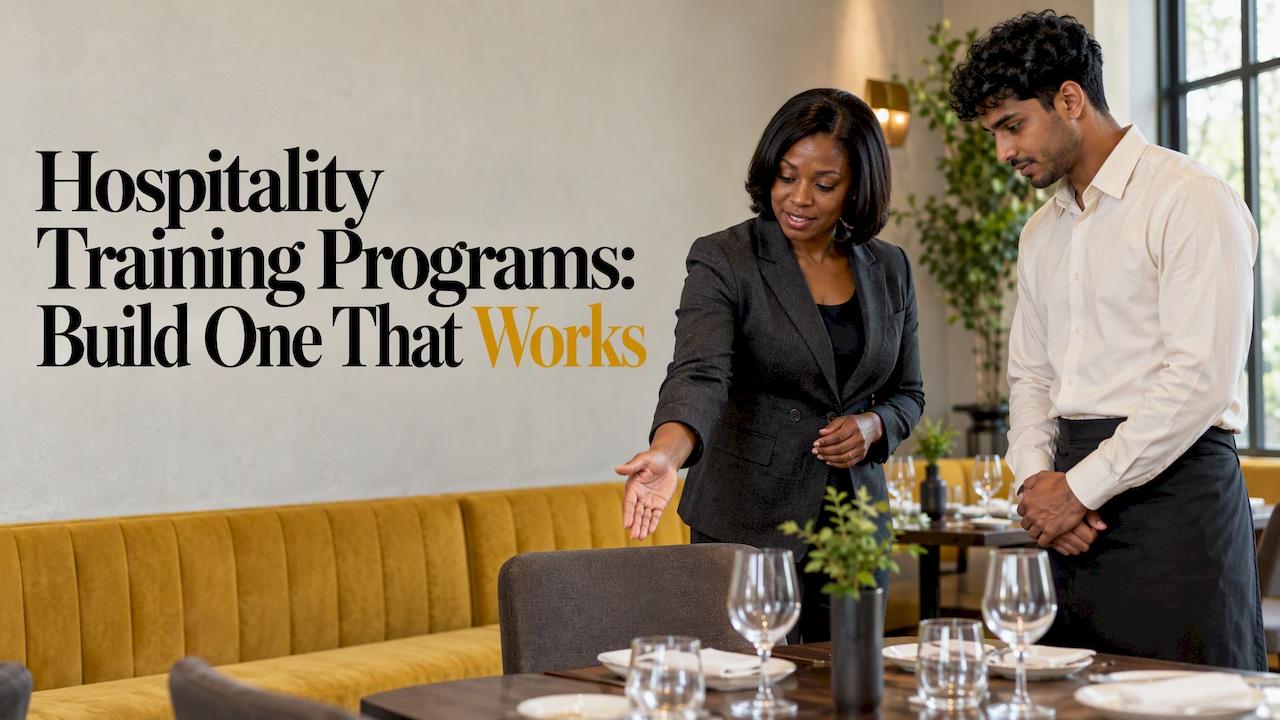
A good hospitality training program does four things. It starts from the skill gaps on your own floor, maps content to each role, is delivered on the job as well as in a classroom, and is measured against guest and business results. Buying a course catalog does none of that for you. This guide shows hotel and restaurant operators how to build the program step by step, with checklists for the front desk and for servers.
TL;DR
- Start with a needs assessment: map roles, inventory skills, and sort gaps into strengths, improvement needs and urgent gaps.
- Build a modular plan: shared onboarding, role-specific modules and refreshers that can be rearranged for each position.
- Use checklists for the front desk and servers so every new hire is trained to the same standard.
- Treat safety training as its own track, delivered in a language every worker understands and reviewed every year.
- Decide the business result before training starts, then track guest satisfaction, turnover and check size, not just completion.
Table of Contents
- What a hospitality training program actually includes
- Start with a training needs assessment
- Build the plan by role and experience level
- Front desk training checklist
- Server training checklist
- Treat safety and compliance as a separate track
- Deliver training so it sticks
- Measure whether training changes results
- Our perspective: training is an operations decision
- Get a plan built around your property
- FAQ
- Sources
What a hospitality training program actually includes
People searching for hospitality training programs usually mean one of two things. Some want a certification or course for themselves. Others run a property and need a program for their team. This article is for the second group: owners, general managers and investors who want consistent service without relying on whoever happens to be on shift to train the new person.
A working program has five parts:
- Needs assessment: what your team can and cannot do today.
- Role map: the skills and standards for each position, from new hires to managers.
- Content and checklists: onboarding, role training and refreshers.
- Delivery: classroom or digital learning combined with coaching on the floor.
- Measurement: the link between training and guest and financial results.
Skip the first and last, and you end up training for problems you do not have and never learning whether it helped.
Start with a training needs assessment
Most operators begin by choosing content. Begin with the gaps instead.
The Institute of Child Nutrition's toolkit, written for food service operations, recommends mapping your organizational structure and site-specific operating conditions first. Then you run a skills inventory covering areas such as food safety, equipment use, standardized recipes and customer service. Results get sorted into strengths, improvement needs and urgent gaps. Finally you set SMART goals for the priority gaps, each tied to a defined performance improvement and a way to track it.
The same discipline applies to hotels. A peer-reviewed study of 193 U.S. hotels with 150 to 300 rooms found that training needs assessments were poorly executed compared with other industries. The authors recommended asking employees for input and having them set performance-improvement goals linked to the organization's goals. The study dates from 1997, but the lesson holds: people who do the job know where the friction is.
Where to find the gaps
You do not need a consultant to start. Pull together what you already have:
- Guest reviews and complaint logs, sorted by theme (slow check-in, wrong orders, unclear billing).
- Operational numbers such as wait times, voids, comps and refunds.
- Performance reviews and manager observations.
- A short staff survey asking what they feel unprepared for.
- Input from department heads, who often see skill gaps before anyone else.
Write each gap as an observable behavior. "Front desk staff are weak on upselling" is vague. "Fewer than one in five walk-in guests are offered a room upgrade" is something you can train and track.
Build the plan by role and experience level
A front desk agent, a line cook and a assistant manager need different things, and a veteran does not need the same onboarding as a first-time hire.
The Institute of Child Nutrition recommends modular plans rather than one-size-fits-all programs. Shared onboarding modules, role-specific modules and periodic refresher modules can be rearranged for different positions and experience levels. New York City's official restaurant onboarding playbook adds the practical layer: determine training length, trainers, company information and key role skills, then prepare checklists, schedules, daily outlines and evaluations.
Here is a simple way to lay that out:
| Module type | Who takes it | Typical content | When |
|---|---|---|---|
| Core onboarding | Every new hire | Brand standards, property or restaurant layout, safety and hygiene basics, how to handle a guest complaint | Week one |
| Role-specific | Each position | Front desk: PMS and check-in. Servers: menu, POS, allergens. Housekeeping: room standards. Managers: scheduling, cost control, coaching | Weeks one to four |
| Cross-training | Proven staff | A second station or department | After 60 to 90 days |
| Refreshers | Everyone | Safety updates, menu changes, service recovery | Quarterly or when something changes |
| Leadership | Supervisors and managers | Coaching, feedback, scheduling, performance reviews | On promotion and yearly |
The ranges in the timing column are a starting point, not a standard. Set them from your own turnover and how long it takes people to become productive.
Front desk training checklist
The front desk is where the guest's impression is set. A leader's guide on front desk first impressions from a hotel training companion series says a front desk checklist should cover guest service and check-in procedures, property procedures, PMS use, hygiene and safety practices, and handling guest requests or complaints.
Turn that into a sign-off list that a trainer and trainee both initial:
- Property knowledge: room types, rates, amenities, local recommendations, emergency exits and who to call after hours.
- Check-in and check-out: greeting standard, ID and payment steps, key issuing, folio review, late check-out and early arrival requests.
- PMS proficiency: creating, modifying and canceling reservations, room assignments, posting charges, running end-of-shift reports.
- Requests and complaints: how to listen, apologize, solve within your authority and escalate beyond it.
- Safety and hygiene: cleaning routines for high-touch areas such as the front desk counter and elevators. AHLA's Safe Stay guidance, published in 2021, put daily cleaning and disinfection of those surfaces among training priorities.
- Sales: offering upgrades, packages and dining, in words that sound like help and not a pitch.
Have the trainee shadow, then do the task while being observed, then do it alone. Sign off only on the third step.
Server training checklist
The National Restaurant Association's job descriptions point to what servers need. A server checklist should include menu knowledge, POS operation, service standards, suggestive selling, allergen and dietary awareness, and payment processing. Build each into something you can test:
- Menu knowledge: a tasting for every dish, a short written or verbal quiz, and the ability to describe each item in a sentence.
- Allergens and dietary needs: the exact steps from table to kitchen to plate, including who is told and how. This one is not optional and should be re-tested regularly.
- POS: entering, modifying and splitting orders, applying comps with manager approval, closing out.
- Service standards: greeting time, seating, order-taking, food timing, check-backs, clearing and farewell.
- Suggestive selling: pairings, specials and add-ons that fit the guest, practiced in role-play before real tables.
- Payments: card handling, cash-outs, tip reporting and what to do with disputes.
Front-of-house training also needs people skills. Restaurant training guidance from Yelp's business resources says front-of-house plans should emphasize interpersonal communication, problem-solving and conflict resolution alongside technical skills. Add a role-play of a late order and an upset guest to the checklist, and score it.
Treat safety and compliance as a separate track
Safety training is where a gap costs the most. OSHA's recommended practices for safety and health programs say that managers and workers should both take part in identifying hazards, training should be in a language and at a literacy level all workers understand, and its effectiveness should be evaluated. For a workforce that may speak several languages, that means translated materials and demonstrations, not only a handout.

The same OSHA document recommends observed demonstrations of skills, written performance assessments and periodic review of training content so it reflects current techniques. In practice, that is a walk-through on the kitchen floor, a short test, and a yearly review of what you teach.
Typical safety modules for a hotel or restaurant:
- Food safety and temperature control
- Responsible alcohol service, following your state's rules
- Slips, burns, cuts and lifting
- Chemical handling for housekeeping and kitchen staff
- Emergency procedures and guest incidents
Train managers on what happens when something goes wrong, too. If a guest reports illness, staff should know to document it and whom to tell. This walk-through of the steps after a food poisoning report is a French-market example of the kind of incident procedure worth rehearsing. Check the reporting rules in your own state and county health department.
Deliver training so it sticks
A one-time orientation fades within weeks. The pattern that holds up combines several formats: digital or classroom learning for knowledge, on-the-job coaching for skill, short pre-shift huddles for reinforcement, and immediate feedback after observed performance.
New York City's playbook says operators should set clear goals and expectations, give consistent formal and informal feedback, and involve the full team in training. A few habits make that real:
- Pick trainers deliberately. The best server is not automatically the best trainer. Give trainers a script, a checklist and time off the floor.
- Use five-minute huddles. One topic per shift: today's special, a recent complaint, a safety reminder.
- Give feedback the same day. Praise specifics and correct privately.
- Plan refreshers. Menu changes, seasonal peaks and new systems are natural triggers.
- Involve department heads. They know the gaps and own the follow-up.
Measure whether training changes results
Completion rates tell you who sat through the content. They do not tell you whether service improved.
A Hotel Management article from August 2025 on measuring training recommends that you define the behavior to change and the business result that will prove success before training begins. You agree measurable KPIs with stakeholders and set assessment timelines. It points beyond completion to outcomes such as guest satisfaction, turnover, injuries, internal promotion and chargebacks.
Here is how that looks for a few common goals:
| Training goal | Behavior to observe | Business measure |
|---|---|---|
| Faster, friendlier check-in | Greeting and ID steps done in order | Check-in time, guest review mentions of arrival |
| Better allergen handling | Table-to-kitchen steps followed every time | Allergen incidents, guest complaints |
| Stronger upselling | Upgrade or add-on offered to each guest | Average check size, upgrade revenue per arrival |
| Quicker ramp-up | New hires pass sign-offs on schedule | Time to full productivity, first-90-day turnover |
| Fewer cash errors | Correct POS and close-out procedure | Voids, variances, chargebacks |
Pull a baseline before the program starts, so you have something to compare against. Then review at 30, 60 and 90 days, and again after six months. If a number does not move, check whether the training was the problem or whether something else, such as scheduling, tools or pay, is in the way.
Our perspective: training is an operations decision
Most training problems we see are not training problems at first. A property says staff need customer service training, and then the data shows slow check-ins caused by a clumsy workflow, or complaints concentrated on one shift with no manager coaching it. Training that ignores that context gets a good attendance record and no change in guest scores.
That is why we start with the numbers: market trends, guest feedback, occupancy and retention. Our approach is data-driven. We use that evidence to decide which roles need what, in which order, and what the guest or revenue result should be. Then the training plan is built around the property, whether it is a boutique hotel or an upscale restaurant, instead of pulled from a generic catalog.
Our clients' testimonials point to gains in occupancy and customer retention, and we believe the reason is simple: training, marketing and operations pull in the same direction. When the promise made to guests in marketing matches what the front desk and servers actually deliver, repeat business follows. If you want a second pair of eyes on your gaps before you spend on a program, that is the work we do.
La’Quentin
Get a plan built around your property
If you would rather not build this alone, we work with hotel and restaurant owners and hospitality investors on strategy, operational support and performance optimization, starting from your guest feedback and market data. Our hospitality marketing strategies connect what you promise guests with what your team delivers.

When you are ready to talk through your goals and priority gaps, book a consultation.
FAQ
How long should a hospitality training program be?
There is no standard length. The NYC playbook tells operators to decide training length, trainers and key role skills based on their own establishment's needs. Many operators run a structured first week plus role training over the first month, then refreshers. Set the length by how long it takes new hires to pass your sign-offs.
What should a hospitality training plan cover for managers?
Managers need the operational skills of their department plus leadership: coaching, giving feedback, scheduling, handling escalated complaints and reading performance data. They also need to know how to run the training itself, including sign-offs, huddles and follow-up. Define these as a separate leadership module so it does not get lost in staff onboarding.
What skills should hospitality staff be trained in?
Common priorities are communication, de-escalation, emotional intelligence, role-specific tools such as the POS or property management system, food safety, responsible alcohol service, workplace safety and leadership. Your needs assessment should decide the order. Start with whatever your guest feedback and operating numbers show is costing you most.
How do I know if training is working?
Decide the behavior and business result before training starts, then compare against your baseline at regular intervals. Look at guest satisfaction, turnover, injuries, average check size and complaints. Completion rates alone only show attendance.
Sources
- Identify Your Training Goals and Staff Needs, Institute of Child Nutrition
- Structure a Training Plan That Fits Your Team, Institute of Child Nutrition
- An Analysis of Training Budgets and Training Needs in U.S. hotels, Journal of Hospitality & Tourism Research
- Restaurant Playbook: Training, NYC Business
- Front Desk First Impressions leader's guide
- AHLA Safe Stay Guidelines, Version 5
- Restaurant Industry Job Descriptions, National Restaurant Association
- Recommended Practices for Safety and Health Programs, OSHA
- Measuring what matters: Turning hospitality training into real results, Hotel Management