
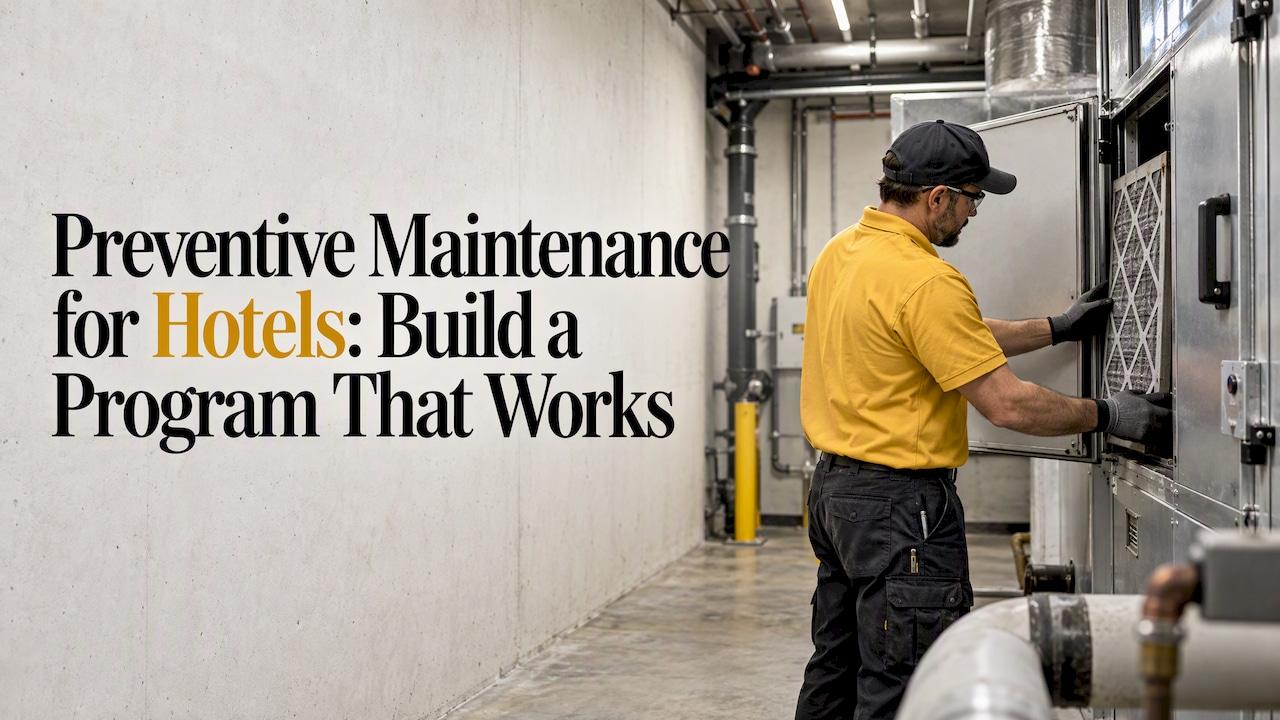
A hotel preventive maintenance program is a written, scheduled routine for inspecting and servicing every building system before it fails: HVAC, plumbing, elevators, kitchen equipment, life-safety systems and guest rooms. The goal is simple. You pay for a small, planned task today instead of an emergency repair, a comped room and a bad review next week. This guide shows how to build one, who owns each task, what to track and where owners usually go wrong.
TL;DR
- Preventive maintenance means scheduled inspections and servicing based on time or usage. It replaces "fix it when it breaks" with a calendar and a record.
- Start with an asset inventory, rank assets by guest and revenue impact, then assign frequencies, owners and documentation for each.
- HVAC deserves its own track: ANSI/ASHRAE/ACCA Standard 180-2018 is the national reference for commercial HVAC inspection and maintenance.
- Housekeeping and the front desk must feed the same work-order queue as engineering, or guest-facing defects slip through.
- Measure the program: planned versus emergency work, repeat room outages, energy and water use, and guest complaints tied to maintenance.
Table of Contents
- What preventive maintenance covers in a hotel
- Why it pays: the business case
- Step 1: Build the asset inventory
- Step 2: Set tasks, frequencies and owners
- Step 3: Give HVAC its own standard
- Step 4: Close the loop with housekeeping and the front desk
- Step 5: Track what matters
- Common mistakes in hotel maintenance programs
- Our perspective: maintenance is a guest-experience and profit lever
- Sustainability: where maintenance meets guest expectations
- A 90-day plan to get started
- How we can help
- FAQ
- Sources
What preventive maintenance covers in a hotel
The term gets used loosely, so it helps to separate three approaches:
| Approach | Trigger | Example | Weakness |
|---|---|---|---|
| Reactive | Something fails | Replace a failed PTAC compressor after a guest complains | Highest disruption and cost, rooms go out of order |
| Preventive | Calendar or run-time | Clean condenser coils each spring, test fire pumps on schedule | Can service assets that did not need it |
| Predictive | Live data readings | Building automation alerts when a motor draws abnormal current | Needs sensors, data and someone who acts on it |
Most independent and mid-size hotels should master the middle row first. Predictive maintenance is the next step, and the U.S. Department of Energy's Better Buildings program describes it as using data from building automation systems or sensors to trigger work orders rather than servicing on a fixed calendar. It only pays off once your basic routines are disciplined and documented.
A complete hotel program covers four zones:
- Guest rooms and corridors. Lighting, locks, TVs, bathroom fixtures, caulking, wall damage, in-room HVAC, smoke detectors.
- Building systems. Boilers, chillers, rooftop units, air handlers, water heaters, pumps, elevators, generators, fire and life-safety systems.
- Food and beverage. Refrigeration, hood exhaust, dish machines, grease traps, ice machines.
- Exterior and amenities. Roofing, parking, pool and spa equipment, fitness equipment, landscaping, signage.
Why it pays: the business case
Owners often see maintenance as a cost line to trim. It is better read as protection for revenue and capital.
Lower lifetime cost. The U.S. Department of Energy's Federal Energy Management Program, in its Operations and Maintenance Best Practices Guide, reports that well-run preventive programs cost 12% to 18% less than reactive ones. Your savings will vary by property, but the direction is consistent: planned work is cheaper than emergency work.
Fewer out-of-order rooms. A room with a failed air conditioner or a leaking shower cannot be sold. Every night it sits in that state is lost revenue, and a guest who gets a defective room is more likely to say so online.
Longer equipment life. Chillers, boilers and kitchen refrigeration are expensive to replace. Cleaning, lubrication, calibration and filter changes are what get them to the far end of their service life, which postpones capital spending.
Lower utility bills. Maintenance and efficiency are the same project. According to the EPA's WaterSense guidance for hotels, water-efficient upgrades and practices can lower operating costs by about 11% and reduce water and energy use by roughly 15% and 10%. The same document describes a San Antonio hotel that upgraded restroom fixtures and now saves 7 million gallons of water and $35,000 in water and sewer bills each year. Leaking flappers, worn aerators and drifting flow rates are exactly what a room-inspection routine catches.
Audit and owner confidence. Investors, lenders and franchisors want to see records. A documented program shows that the asset is being protected, which supports valuation and smooths property improvement plan (PIP) conversations.
Step 1: Build the asset inventory
You cannot maintain what you have not listed. Walk the property with the chief engineer and record, for every asset:
- Unique ID and tag (a QR code or barcode label works well)
- Location, make, model, serial number and install date
- Warranty status and service contract, if any
- Manuals and vendor contact
- Criticality rating (see below)
In a 150-room select-service hotel this usually means a few hundred line items once you count each guest-room air conditioner, water heater and door lock group. Rooms can be handled as repeating templates so you are not writing 150 separate entries.
Rank by criticality
Not every asset deserves the same attention. A simple three-level ranking works:
- Critical: failure creates a safety risk, shuts the hotel or a whole floor, or stops a revenue outlet. Think fire pumps, elevators, main boilers, kitchen walk-in coolers.
- Important: failure hurts guest experience or takes rooms offline one at a time. Think in-room HVAC, hot water to a wing, ice machines.
- Routine: failure is an inconvenience. Think lobby decor lighting, some furniture.
Critical assets get the tightest frequencies, the best documentation and a named backup vendor.
Step 2: Set tasks, frequencies and owners
For each asset, define what is inspected, how often, by whom and what a pass looks like. Start from manufacturer recommendations, add code and insurer requirements, then adjust for your climate and occupancy. A coastal Florida resort and a Minneapolis business hotel do not run the same filter schedule.
A practical rhythm looks like this:
| Frequency | Typical tasks | Owner |
|---|---|---|
| Daily | Walk mechanical room, check pressures and temperatures, log readings, scan public areas for damage | Engineer on duty |
| Daily, during room turns | Report damaged fixtures, stains, dead bulbs, odd noises or smells | Housekeeping |
| Weekly | Test emergency lighting, check pool chemistry logs, inspect ice machines | Engineering |
| Monthly | Change or inspect filters, check belts, test door locks and sensors on a sample of rooms | Engineering |
| Quarterly | Deep-inspect rooms on a rotating schedule, clean coils, check water heater and boiler controls | Engineering or vendor |
| Annual | Service elevators, fire alarm and sprinkler inspections, roof inspection, kitchen hood cleaning | Licensed contractors |
Treat that table as a template, not a code reference. Fire, elevator and kitchen exhaust intervals are set by local code, your insurer and the authority having jurisdiction, so confirm them with the licensed contractor and your local fire marshal before you lock the calendar.
Rotate deep room inspections
A common mistake is to wait until a full renovation to find room defects. Instead, pick a number of rooms each week (for example, a floor or wing per month) and check everything: lighting and bulbs, outlet function, caulk, grout, toilets and flush valves, shower flow, TV and remote, door closers, closet rods, mattress platforms, and in-room HVAC performance. Done on a rotation, every room gets a full look several times a year without taking big blocks of inventory offline.

Step 3: Give HVAC its own standard
HVAC is usually the largest energy user and the most common source of comfort complaints, so it earns a dedicated program. ANSI/ASHRAE/ACCA Standard 180-2018 provides minimum inspection and maintenance requirements for commercial HVAC systems and calls for documenting tasks, frequencies and results. Use it as the backbone when you write specifications for your mechanical contractor.
The contract should state which tasks the contractor performs, which your team performs, and what reports you receive after each visit. Keep the reports in the same system as your work orders so nothing lives in a vendor's inbox.
Maintain set-points, not just machines
A unit can be "working" and still waste energy. The Better Buildings program profiles HEI Hotels & Resorts, which created a standard operating procedure for chief engineers and select department heads to determine, monitor and maintain key energy set-points across its hotels. Adopt the same idea. For each plant, write down the intended supply and return temperatures, pressure settings, schedules and setbacks, and check them on rounds. Keep these in a property-specific plant notebook so a new chief engineer, an owner's auditor or a vendor can see what "normal" means in your building.
Step 4: Close the loop with housekeeping and the front desk
Engineers cannot fix what they never hear about. Housekeepers see every room every day, and the front desk hears every complaint. Both are your best sensors.
What works:
- One intake channel. A single work-order system or app that housekeeping, front desk and engineering all use. Hospitality maintenance software providers such as UpKeep describe this guest-facing repair queue as the way to keep preventive work from being crowded out by reactive requests.
- Photo and room number at the point of discovery. Attendants report from the cart, not from memory at end of shift.
- Priority codes. Safety or no-water issues are same-hour. A loose towel bar can wait for the weekly route.
- Close-out feedback. The reporter sees that the ticket was completed. Staff stop reporting if nothing ever seems to happen.
- Room status link. Engineering holds the room out of inventory only when necessary, and the front desk sees when it returns.
This is mostly a management problem, not a technology problem. Someone has to review the queue daily and enforce response times.
Step 5: Track what matters
A program you do not measure drifts back to firefighting. Pick a small set of indicators and review them monthly with the general manager and owner:
- Planned versus unplanned work ratio. More planned work over time means the program is taking hold.
- Preventive maintenance completion rate. Percentage of scheduled tasks finished on time.
- Out-of-order room nights. Total, and by cause.
- Repeat failures. The same room or asset failing twice in a quarter signals a root cause you have not fixed.
- Guest complaints citing maintenance. Pull these from survey comments and review sites.
- Utility cost per occupied room. Water, electricity and gas, tracked against occupancy and weather.
- Maintenance cost per available room. Separate labor, parts and contractor spend.
Share the results with department heads. When housekeeping sees that its reports cut room outages, participation goes up.
Common mistakes in hotel maintenance programs
- Writing the schedule once and never revising it. Update frequencies after each failure and each season.
- Letting emergencies cancel the plan. Reactive work always feels urgent. Protect a fixed block of technician hours for planned tasks each week.
- Understaffing without a vendor plan. Lean teams should shift specialized tasks (elevators, chillers, fire systems, kitchen exhaust) to contractors and focus staff on rounds and room inspections.
- Ignoring documentation. If a task is not recorded, an insurer, franchisor or buyer will treat it as not done.
- Skipping training. A checklist is only as good as the person following it. Walk new technicians through what a pass and a fail look like.
- Cutting maintenance to hit a short-term budget. Deferred work shows up later as capital expense and lost room nights.
Our perspective: maintenance is a guest-experience and profit lever
We look at hotels and restaurants through data: market trends, guest feedback and operating results. Seen that way, maintenance rarely fails because a team does not care. It fails because nobody connects the work to what guests say and what the P&L shows.
When a property's reviews keep mentioning slow showers, noisy air conditioners or tired bathrooms, those comments are a maintenance backlog written by customers. We encourage owners to read guest feedback alongside work-order data. The patterns tell you which rooms, which systems and which weeks need attention, and they let you rank spending by guest impact instead of by whoever complains loudest internally.
We also push owners to think about maintenance as part of the guest promise, not a back-of-house cost. A property that markets comfort, cleanliness or a wellness stay has to keep the physical product consistent with that story. Marketing that outruns the building produces disappointed guests and weaker retention.
If you are deciding where to start, our advice is modest: build the inventory, protect the weekly planned-work hours, make reporting easy for housekeeping, and review a one-page scorecard every month. Do those four things for a quarter and you will know far more about your building than you do today.
— La’Quentin
Sustainability: where maintenance meets guest expectations
Guests and corporate travel programs increasingly ask about environmental practices, and maintenance is how a property actually delivers them. Properly calibrated HVAC, repaired leaks, efficient fixtures and tuned controls reduce consumption without asking guests to give anything up. The EPA's hotel guidance notes that water used in lodging facilities accounts for a significant share of a property's total consumption, and that fixture upgrades and linen reuse programs are proven ways to reduce it. Larger properties go further: the Better Buildings case study on The Venetian and The Palazzo shows how a campus-level property identified energy and water efficiency opportunities through its metering and engineering work.
If you intend to pursue ENERGY STAR or similar benchmarks, your maintenance records are the evidence base. Set-point logs, leak repairs and equipment service history all help show what changed and when.
A 90-day plan to get started
Days 1 to 30: Foundation. Walk the property and build the asset list. Rate criticality. Collect warranties and manuals. Choose a work-order tool, even a simple one. Pull 12 months of repair history and guest comments to find the repeat offenders.
Days 31 to 60: Schedules. Write tasks and frequencies for critical and important assets first. Meet with contractors to confirm scopes and reports. Train housekeeping and the front desk on reporting. Begin the rotating room inspection.
Days 61 to 90: Discipline. Run the program for a full month with weekly check-ins. Review completion rates, adjust frequencies, and present the first scorecard to ownership. Decide what budget the next year's capital plan needs based on what you found.
How we can help
For owners who want an outside view of how operations, guest feedback and revenue connect, we offer data-driven consulting for hotels and restaurants, built around your market and your property. You can see our approach to hospitality marketing strategies or book a consultation to talk through your operation. We do not publish pricing for these engagements, so the consultation is the way to scope what fits your property.
FAQ
What counts as preventive maintenance in a hotel?
It is any planned inspection, cleaning, adjustment or part replacement done on a schedule, before a failure. Changing HVAC filters, testing emergency lighting, descaling ice machines and checking guest-room fixtures on a rotation all qualify. Fixing something after it breaks is reactive maintenance.
How often should hotel rooms be inspected?
Housekeeping should report defects during every room turn, while engineering performs a deeper inspection on a rotating basis. Many properties cover every room several times a year by checking a set number each week. Set the cadence by your room count, age of the building and staffing.
What is the difference between preventive and predictive maintenance?
Preventive maintenance follows a calendar or usage schedule. Predictive maintenance uses live data from sensors or a building automation system to trigger work only when readings suggest a problem. Most hotels should get the preventive basics working before adding sensors.
Who should be responsible for the maintenance program?
The chief engineer or director of engineering owns the program, and the general manager holds the department accountable for results. Housekeeping, front desk and food and beverage teams all contribute by reporting issues quickly through the same system.
Do small hotels need a formal program?
Yes, but it can be simple: an asset list, a monthly and annual calendar, a shared reporting channel and a one-page scorecard. Lean teams benefit most, because they cannot afford the downtime that comes from surprise failures.
Sources
- ASHRAE: Standards 180 and 211-2018 fact sheet
- EPA WaterSense: Water efficiency fact sheet for hotels
- U.S. DOE FEMP: Operations and Maintenance Best Practices Guide, Release 3.0
- Better Buildings: HEI, Chasing Quarters With Energy Set-Points
- Better Buildings: Las Vegas Sands, The Venetian and The Palazzo
- UpKeep: Maintenance software for hotels and hospitality