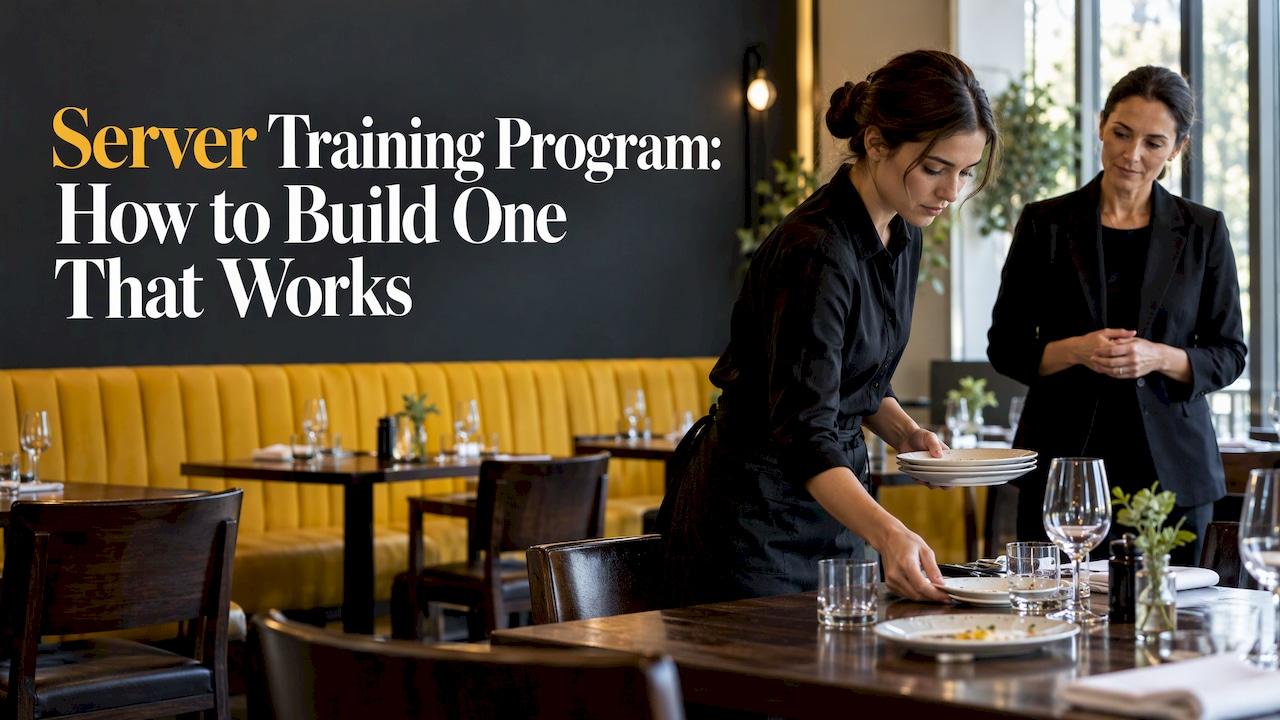
A good server training program has four parts: a short orientation, shadowing with a trained server, supervised solo shifts, and a formal sign-off. It then continues with refreshers and measurable goals. Where you serve alcohol, state-approved responsible service training sits on top of that, and in several states it is a legal requirement. This guide shows what to teach, in what order, how long each phase takes, and how to tell whether the training is working.
TL;DR
- Cover four things: written service standards, technical skills (POS, payments), menu and allergen knowledge, and opening, closing and safety procedures.
- Run onboarding in phases: a 3 to 4 hour orientation, 2 to 4 shadow shifts, supervised solo shifts in a small section, then a signed assessment.
- Check your state's alcohol server rules. Deadlines range from 30 to 120 days after hire, and renewals from two to four years.
- Track speed, accuracy, guest satisfaction and sales per server, and schedule refreshers when the menu, POS or standards change.
- Pick trainers on purpose and give them a written guide to follow.
Table of Contents
- What a server training program should cover
- A phased onboarding schedule
- Choose and prepare your trainers
- Responsible alcohol service training
- Measure results and schedule refreshers
- Our perspective: training is an operating system, not an event
- Get help building your program
- FAQ
- Sources
What a server training program should cover
Most weak training fails because it is improvised: a new hire follows whoever is on the floor and absorbs that person's habits. A written program fixes that. RestaurantOwner lists the usual content: menu descriptions and preparation, sampling every menu item, customer service standards, responsible alcohol service, POS operation, restaurant policies and side work, wine service where it applies, and safety and sanitation.
A simple way to organize that is the four-component model described by Xenia:
- Written service standards. What a greeting, a check-back and a farewell look like in your restaurant.
- Technical skills. POS, payments and reservations.
- Menu and allergen knowledge. Ingredients, preparation, pairings and what to say when a guest asks about an allergy.
- Operational procedures. Opening, closing, safety and emergencies.
Write the service standards down
Standards only work when they are concrete enough to observe. Oysterlink's server manual template suggests expectations such as greeting guests within 60 seconds of seating, taking orders accurately and promptly, pre-bussing, handling concerns professionally, and upselling specials when appropriate. Use your own numbers, but keep the habit: if a trainer cannot watch for it, a trainee cannot be graded on it.
Teach the menu by tasting it
A server who has never tasted the short rib cannot sell it. Build tasting into the first week: every menu item sampled, with a one-page cheat sheet per dish covering main ingredients, cooking method, common modifications and the major allergens. Quiz on it before the first solo shift, not after.

Teach allergens as a safety skill
Food allergens belong in training from day one. Dining Room Management notes that FDA rules under FALCPA identify nine major food allergens that server training must address. Train servers to ask, to never guess, to bring the kitchen in, and to know how the order is flagged at the ticket and at the pass. For a broader look at who carries responsibility when an allergy incident happens in a dining room, see this piece on restaurant food allergy responsibility.
A phased onboarding schedule
Structured programs tend to follow three sequential phases, according to Dining Room Management: onboarding, role-specific skills training, and ongoing performance development. The step-by-step version from 7shifts translates into a schedule most independent restaurants can run.
| Phase | Typical length | What happens | Who signs off |
|---|---|---|---|
| Day-one orientation | 3 to 4 hours | Paperwork, tour, introductions, uniform, staff meal, how the training period and evaluations work | Manager |
| Shadowing | 2 to 4 shifts | New hire follows an experienced server and watches the full table cycle | Trainer |
| Supervised solo shifts | Several shifts | Small section, slower service, trainer nearby | Trainer |
| Formal assessment | One session | Menu quiz, POS competency test, observed service | Trainer and manager |
Keep day one short
Orientation should not be an information dump. 7shifts recommends three to four hours covering paperwork, the tour, introductions, uniform and an employee meal, plus a clear explanation of how the training period and evaluations work. Restaurant365 adds culture, values and mission, a menu overview, and housekeeping such as uniform policy, scheduling and how to request time off. Leave the deep menu and POS work for the shifts that follow, where it sticks.
Shadow, then serve with a safety net
During shadowing, give the trainee a checklist of what to watch: greeting, ordering, timing of courses, handling a complaint, closing out a check. Then move to supervised solo shifts, starting with a small section during slower service. Increase the section size only as the trainer signs off each skill.
End with a real assessment
The sign-off should be a menu quiz, a POS competency test and observed service, with both the trainer and a manager signing. A trainee who passes one part and not another repeats only the part they missed. Put the result in the employee file so the next review has a baseline.
Choose and prepare your trainers
One of the most common mistakes is pairing a trainee with an employee who has never been taught how to train. RestaurantOwner recommends selecting staff who are patient, want to be trainers, are strong servers, and are willing to follow a set of training guidelines instead of teaching off the cuff.
In practice:
- Ask for volunteers and observe their service first.
- Give each trainer the same written checklist the trainee gets.
- Hold a short trainer briefing before each new class starts.
- Recognize the role with a pay differential or a scheduling priority, so it is not seen as extra unpaid work.
Responsible alcohol service training
If your restaurant pours alcohol, this module is non-negotiable. According to RestaurantOwner, employer-sponsored alcohol awareness training should cover regulations, service to minors, the effects of alcohol, spotting intoxicated patrons, intervention methods, BAC information, a test, and a certificate of completion.
Toast describes the same core: laws on serving minors and intoxicated guests, the effects of alcohol, correct ID checks, how and why to refuse service, and how servers protect themselves and the business from liability. It also suggests collecting a copy of each staff member's certificate after the course, and either hosting a course on-site once a year or having staff take a locally recommended course before they start.
Back your staff up. Toast's guidance is that staff safety matters more than the revenue from a group ordering round after round, and that managers should show they trust their team's judgment and will support a cut-off. Say this out loud in training, then act on it the first time it happens.
What state rules require
Requirements differ by state and sometimes by county, so confirm the current rule with your state alcohol agency. The table shows how much they vary.
| Jurisdiction | Who | Deadline after hire | Validity | Source |
|---|---|---|---|---|
| California | Alcohol servers | 60 calendar days | 3 years | BPC § 25682, Xenia |
| Cook County, Illinois | Alcohol servers (BASSET) | 120 days | 3 years | Illinois statute |
| Tennessee | All alcohol service employees | 61 days | 2 years (from January 1, 2025) | ServSafe guidelines |
| Nevada | Anyone who serves, sells or handles alcohol | 30 days | 4 years | LegalClarity |
| Pennsylvania | Owners, managers, servers, ID checkers | Check state rules | Renew every 2 years | TIPS |
A few details worth knowing:
- California's law, in force since July 1, 2022, bars a licensee from employing an alcohol server without a valid certification, with 60 calendar days to obtain it for new hires.
- Illinois Public Act 99-0046, signed in July 2015, requires servers and ID checkers in on-premise establishments to complete BASSET every three years, with the effective date tied to county population, according to Prevention First.
- In Tennessee, the approved course must include at least 3.5 hours of instruction and written materials, and the permit fee for the employee on-premise permit is $20.00, per the same ServSafe guide.
- Pennsylvania's RAMP Server/Seller training became mandatory in 2016, per TIPS.
- Nevada's card comes from a state-approved course and an in-person proctored exam. Course and exam fees generally run $15 to $30 combined, according to LegalClarity.
Build a tracker with each server's course date, certificate number and expiry date, and set reminders 60 days before renewal. A lapsed certificate on an inspection day is an avoidable problem.
Measure results and schedule refreshers
Training that is never measured drifts. Set evaluation points at 30, 60 and 90 days, as Oysterlink suggests, with a checklist for each milestone. Altametrics groups the useful indicators into four families:
- Speed: table turn times, time to greet, time between check-backs.
- Accuracy: order errors, POS entry mistakes, comps or voids caused by server error.
- Guest satisfaction: comment cards and online reviews.
- Sales: average check size, upsell rate, beverage attach rate.
Pick three or four to start. Too many numbers and nobody acts on them. The principles in this guide to performance indicators that matter apply here: choose measures people can influence, review them on a fixed rhythm, and turn each into one concrete piece of feedback.
When to retrain
Altametrics recommends refreshers when the menu changes seasonally, new POS features roll out, service standards are updated after guest feedback trends, or one server's performance slips in a specific area. A 15-minute pre-shift session for a menu change often does more than a long annual meeting. Target the retraining to the skill that slipped rather than repeating the whole program.
Our perspective: training is an operating system, not an event
We look at server training the way we look at everything in hospitality management: as a system that should produce measurable results.
Our approach is data-driven. We analyze market trends and guest feedback, then build strategies around what the numbers show about a specific property. For training, that means we begin with the questions that matter. Where do guests say service falls short? Which dishes do servers fail to sell? Where does the shift lose time? The answers decide what the program emphasizes.
We believe a program should be tailored to the operation. A boutique hotel dining room and an upscale restaurant do not share the same service rhythm, and a generic manual treats them as if they do. Our aim in every engagement is to connect training to guest experience, retention and profitability, then to keep checking that connection.
The strongest programs we see have written standards, trained trainers, dated check-ins and a manager who reads the results. That is operational support in its simplest form: the habits are built into the week, not left to chance.
La’Quentin
Get help building your program
If you own a restaurant or hotel and want training tied to guest experience and revenue, our team can help. We offer strategic consulting, operational support and performance optimization built on market and customer feedback analysis. Learn more about our hospitality management services, or start with a consultation to talk through your operation.

We work with hotels, restaurants and hospitality investors, and we shape each engagement around the property's own goals.
FAQ
How long should server training take?
Plan on a 3 to 4 hour orientation, followed by two to four shadow shifts and several supervised solo shifts. The formal assessment comes at the end. Most restaurants finish the core program in one to two weeks, then continue with 30, 60 and 90 day check-ins.
Do all servers need alcohol server certification?
Not in every state. Some require it by law, with deadlines such as 60 days after hire in California or 30 days in Nevada, while others leave it to employers or insurers. Check your state alcohol agency's current rules, and consider training all servers anyway as a standard of care.
What should a server training manual include?
Include service standards, the menu with allergens, POS instructions, side work lists, opening and closing procedures, safety and sanitation policies, and alcohol service rules. Add a checklist for each milestone and the evaluation schedule so trainers and trainees see the same expectations.
Who should train new servers?
Choose patient, strong servers who want the role and will follow written guidelines. RestaurantOwner warns against assigning trainees to employees with no training instruction. Give trainers a briefing and a checklist before every class.
How do I know if training is working?
Track speed, accuracy, guest satisfaction and sales per server against the baseline from the assessment. Review at 30, 60 and 90 days. If a number slips, retrain on that specific skill.
Sources
- The Fundamentals of an Effective Server Training Program, RestaurantOwner
- The Complete Guide to Front-of-House Restaurant Training, Xenia
- Training Dining Room Employees: Programs and Best Practices, Dining Room Management
- Server Training Manual Template, Oysterlink
- How to Train Restaurant Servers, 7shifts
- How to Train a Server, Restaurant365
- How to Train Restaurant Servers, Altametrics
- How to Do Alcohol Training for Servers, Toast
- California Business and Professions Code § 25682
- Illinois Liquor Control Act § 5/6-27.1, FindLaw
- Mandated Beverage Service Training, Prevention First
- Tennessee Program Roll-Out Guidelines, ServSafe
- Pennsylvania Alcohol Server Training, TIPS
- How to Get Your Alcohol Awareness Card in Nevada, LegalClarity
- Restaurant food allergy responsibility, Spoon
- Project performance indicators, FluidOps