
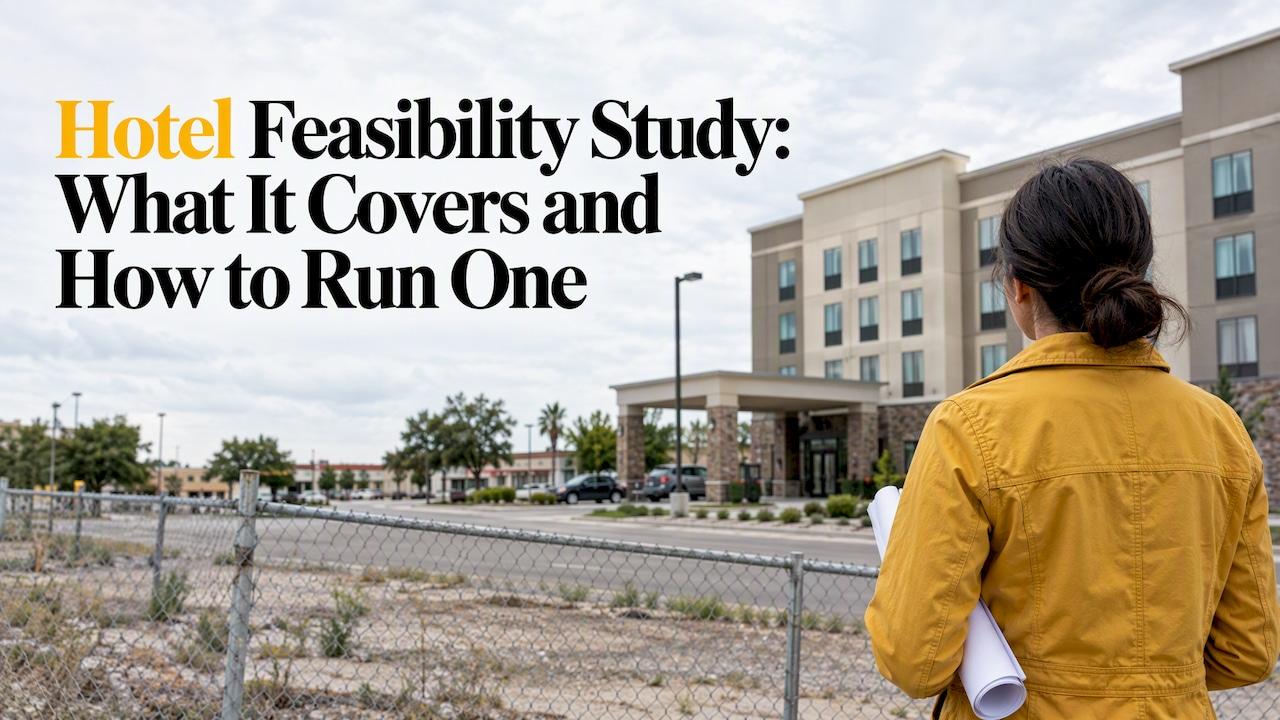
A hotel feasibility study is a structured, evidence-based assessment of whether a proposed or existing hotel project can succeed in a specific place. It tests market demand, competing supply, development cost and projected returns, so you can decide whether to build, buy, reposition or walk away before the big money is spent. This guide covers what goes into one, how to do it in order, what it should cost you in time and attention, and where owners most often get it wrong.
TL;DR
- A feasibility study answers one question: will this hotel, at this site, with this brand and budget, earn enough to justify the investment and satisfy a lender?
- It has four working parts: market and demand analysis, site and competitive review, development cost, and a multi-year financial forecast.
- Build the forecast on standard operating statement formats, and test it with downside cases, not just the base case.
- The study is not a one-time document. Development takes years, so costs and revenue assumptions need to be revisited as conditions change.
- Generic cost averages are a starting point only. Get project-specific estimates before you commit.
Table of Contents
- What a hotel feasibility study actually is
- Feasibility study vs. market study
- What goes into the study
- How to do a hotel feasibility study, step by step
- Doing it in-house or hiring outside help
- Common mistakes that sink a study
- What the study should leave you with
- Our perspective
- Where we can help
- FAQ
- Sources
What a hotel feasibility study actually is
Think of it as a decision document. A good one turns market demand, competitive supply and financial assumptions into a multi-year forecast that a lender or partner can scrutinize. It is not a sales brochure for the project, and it is not a rubber stamp. If the numbers do not work, the study should say so plainly.
The people who read it are different, and each looks for something else:
- Owners and developers want to know whether to proceed, and at what size and positioning.
- Lenders want evidence that cash flow will cover debt service in a bad year, not just a good one.
- Franchise companies typically want to see that a new property fits its market before approving a flag.
- Investors and partners want a return profile they can compare with other uses of their capital.
If you are writing for more than one of these readers, say so at the start, because it changes how conservative the assumptions should be.
Feasibility study vs. market study
The two terms get mixed up constantly. A market study quantifies local demand and shows how it is shared among existing and proposed hotels. A full feasibility study goes further: it adds the development budget, the operating projections and the return analysis, and ends with a recommendation. Consultants who serve developers often offer both, because an owner at the earliest stage may only need to know whether the market has room before paying for the full financial work.
A practical rule: if you have not yet secured a site, or you are choosing between several, start with a market-level look. If you have a site and are heading to a lender or a franchisor, you need the full feasibility study.
What goes into the study
1. Market and demand analysis
This is the foundation, and the part most often done too quickly. You are identifying who sleeps in the local market and why: business travelers, leisure guests, group and meeting business, contractors, sports and event visitors, medical travelers. Look at the economic drivers (employers, universities, hospitals, attractions), airline and highway access, seasonality, and any planned demand generators.
Segment detail matters. Demand analysis often misses niche segments that matter in specific places. A Utah State University extension brief on dark-sky tourism notes that overnight visitors in some markets spend up to three times more than day-only visitors, which is why modeling by segment, not just by total visitor counts, leads to better revenue forecasts. If your location draws a specific kind of traveler, build that segment into the model explicitly.
For a small-town or downtown project, university extension programs publish useful starting material. The University of Wisconsin extension guide to evaluating lodging opportunities walks through travel and visitation trends, existing competition and traveler segments for a downtown area.
2. Site and competitive supply
Visit the site at different times of day. Check visibility, access, signage, neighboring uses, noise, parking and walkability to demand generators. Then build a competitive set: the hotels guests will realistically compare yours against, with their room counts, rate positioning, age, brand affiliation and amenities.
Two things people forget:
- The pipeline. Rooms under construction or approved will compete with you on opening day. A study that only looks at today's inventory is out of date before it is printed.
- Non-hotel supply. Short-term rentals can absorb leisure demand in some markets and should be addressed, not ignored.
3. Development cost
The cost section sets the investment the hotel has to repay. Per-room costs differ enormously by product type. A national survey summarized in an industry report on U.S. hotel development costs showed, in its 2018 data, average per-room costs from roughly $95,000 for budget and economy hotels to about $649,000 for luxury. That is a nearly sevenfold spread, and it is why "what does a hotel cost to build" has no single answer.
The same source is clear about the limit of such averages: as of 2025, surveys give a general guide, but actual budgets depend on many project factors, and you should consult construction, design and procurement firms for accurate estimates. Treat averages as a reasonableness check on your own numbers, never as the numbers themselves.
Include in the budget:
- Land and site work
- Hard construction costs
- Furniture, fixtures and equipment
- Soft costs: design, permits, legal, franchise application fees
- Pre-opening expenses and working capital
- Financing costs and a contingency
For an acquisition or conversion, replace the build budget with the purchase price plus the renovation scope, including any property improvement plan a brand requires.
4. The financial forecast
The forecast projects occupancy, average daily rate (ADR) and revenue per available room (RevPAR) over a stabilization period, then converts them into revenue by department, operating expenses, net operating income and returns. Occupancy multiplied by ADR gives you RevPAR, so changes in either one move the whole model.
Format matters for credibility. The American Hotel & Lodging Association points out that operating statements prepared to USALI standards give owners, operators and lenders a common language for operational information. If your pro forma uses a custom layout, lenders have to translate it, and translation invites questions.
At minimum, the financial section should show:
- A ramp-up period before the hotel reaches stable occupancy
- Revenue by department (rooms, food and beverage, other)
- Expenses split into departmental, undistributed and fixed
- Net operating income and debt service coverage
- Returns: cash-on-cash, internal rate of return, and break-even occupancy
How to do a hotel feasibility study, step by step
- Define the concept. Write down the target product (limited-service, select-service, full-service, boutique, resort), room count range, brand or independent, and the amenities you are considering. You will refine this later, but you need a starting hypothesis.
- Gather market data. Collect demand drivers, historical performance for comparable hotels, local economic indicators and the planned supply pipeline. Talk to local hotel managers, the convention and visitors bureau, major employers and event organizers. Interviews often reveal demand that statistics miss.
- Build the competitive set. Select five to eight comparable properties, record their positioning and, where you can get it, their occupancy and ADR trends.
- Estimate demand by segment. Allocate local room-night demand to the segments, then estimate what share your hotel could capture given its quality, location and rate position.
- Set the development budget. Get project-specific quotes. Use survey averages only to check that your figures are in a plausible range.
- Project operations. Forecast occupancy and ADR through ramp-up to stabilization, then model revenue and expenses in a standard format.
- Test the downside. Run a case with lower occupancy, lower rate and higher costs. Find the break-even occupancy and ask whether you can survive a year below it.
- Write the conclusion. State clearly whether the project is feasible as defined, what would make it more feasible (fewer rooms, a different brand, a different site, phased development), and what risks remain.
The International Hospitality Institute publishes a general outline of how to conduct a hotel feasibility study if you want a second framework to compare against.
Doing it in-house or hiring outside help
Owners with hospitality experience can handle much of the groundwork: site visits, local interviews, a first-pass competitive set. Where outside help earns its fee is independence and data. A lender or franchisor will usually give more weight to an analysis prepared by a party with no stake in the project being approved, and an experienced analyst will have access to benchmark data and a feel for what is realistic in your segment.
A workable split for many owners: do the early screening yourself to kill obviously poor ideas cheaply, then commission independent work on the shortlisted project. Ask any provider you consider what data sources they use, how they handle the pipeline, and whether the forecast includes a downside case. Be wary of any study whose conclusion was clearly settled before the research started.
Common mistakes that sink a study
Treating the first draft as final. Development typically takes three to five years. According to the same cost survey coverage, initial cost estimates and revenue projections can go stale quickly because of inflation and shifting market conditions, so the study should be revisited periodically rather than filed away.
Waiting for perfect conditions. An industry analyst quoted in a 2024 report on development costs argued that even with high interest rates and construction costs, there is strategic value in starting the long pre-development phase of feasibility, entitlement and design, because competitors often pause during downturns. That is not a case for rushing. It is a case for doing the analysis early and keeping the option open.
One optimistic scenario. If the project only works at a high occupancy, you do not have a feasible project, you have a hope. Always show the downside.
Ignoring food and beverage and other departments. Restaurants, bars and meeting space can carry heavy staffing and low margins. Model them separately and honestly, and consider whether a leaner offering suits the market.
Using survey averages as a budget. Averages hide the variance that decides your project. Replace them with quotes as soon as you can.
Forgetting the brand. Flag, franchise fees and brand standards change both revenue and cost. An independent can also be a strong choice: one owner profiled by Hotel News Resource, a former Days Inn that dropped its franchise, reimagined the property as an independent. Model both paths when the market allows it.

What the study should leave you with
When you finish, you should be able to answer these without hedging:
- Which segments will fill the rooms, and in which months?
- What occupancy and rate does the hotel need to cover operating costs and debt service?
- How far can demand fall before the project fails to pay its loans?
- What would change the answer: a different size, brand, site or timing?
- When will we re-run the numbers?
If you cannot answer those, the study is not finished.
Our perspective
Most feasibility conversations we have with owners start with the same question: "Will the market support this hotel?" We think the better question is: "What would have to be true for this hotel to perform, and how do we find out cheaply?"
Our approach is data-driven. We look at market trends and at what guests actually say about the properties they stay in, because guest feedback shows unmet needs that raw supply and demand numbers cannot. A competitive set tells you who is nearby. Reviews and feedback tell you where they are failing their guests, and that is often where a new or repositioned property finds its edge.
We also believe a study should end with operations in mind. A projection that ignores how the hotel will be run, marketed and staffed is a spreadsheet, not a plan. The assumptions you put into the model, such as occupancy ramp and rate position, are promises the property has to keep once it opens. That is why we work with hotel and restaurant owners on strategy, operational support and performance optimization, so the numbers on paper connect to what happens at the front desk and in the dining room.
— La’Quentin
Where we can help
If you are weighing a new project, a repositioning or an underperforming property, our team works with hotel and restaurant owners and hospitality investors on strategy, data-driven market analysis, guest feedback evaluation and performance optimization. Our Hospitality Marketing Strategies service is built around translating market insight into a plan for filling rooms and tables. To talk through your situation, you can request a consultation.
FAQ
How long does a hotel feasibility study take?
The timeline depends on market complexity, property type and how much data is available. A straightforward limited-service project in a well-documented market moves faster than a full-service hotel with food and beverage, meeting space and several demand segments. Plan for the study to run alongside site selection, since the result may change which site you pursue.
What is the difference between a hotel feasibility analysis and a market study?
They are often used interchangeably, but a market study focuses on demand and supply, while a full feasibility study adds the development cost, operating forecast and returns, then makes a recommendation. If you only need to know whether the market has room for another hotel, a market study may be enough. If a lender or franchisor is involved, expect to need the full feasibility work.
Do I need a feasibility study if I am buying an existing hotel?
Usually yes, in adapted form. Instead of a development budget, you analyze the purchase price, required renovations and any brand-mandated improvements. You also test the existing operating history against the market to see whether the seller's numbers are repeatable under your ownership.
Can a feasibility study be wrong?
Yes. It is a forecast, and conditions change, particularly over a development period that can span several years. That is why good studies show downside scenarios and why the assumptions should be updated at key milestones, such as before financing closes and before construction begins.
Sources
- Mews: hotel feasibility study guide
- Utah State University Extension: Economics of Dark Skies brief
- University of Wisconsin Extension: evaluating lodging opportunities
- Hotel News Resource: 2025 U.S. hotel development cost survey
- Hotel News Resource: 2024 U.S. hotel development cost survey
- AHLA: committees
- International Hospitality Institute: how to conduct a hotel feasibility study
- Hotel News Resource: Hotel 1550 independence story