
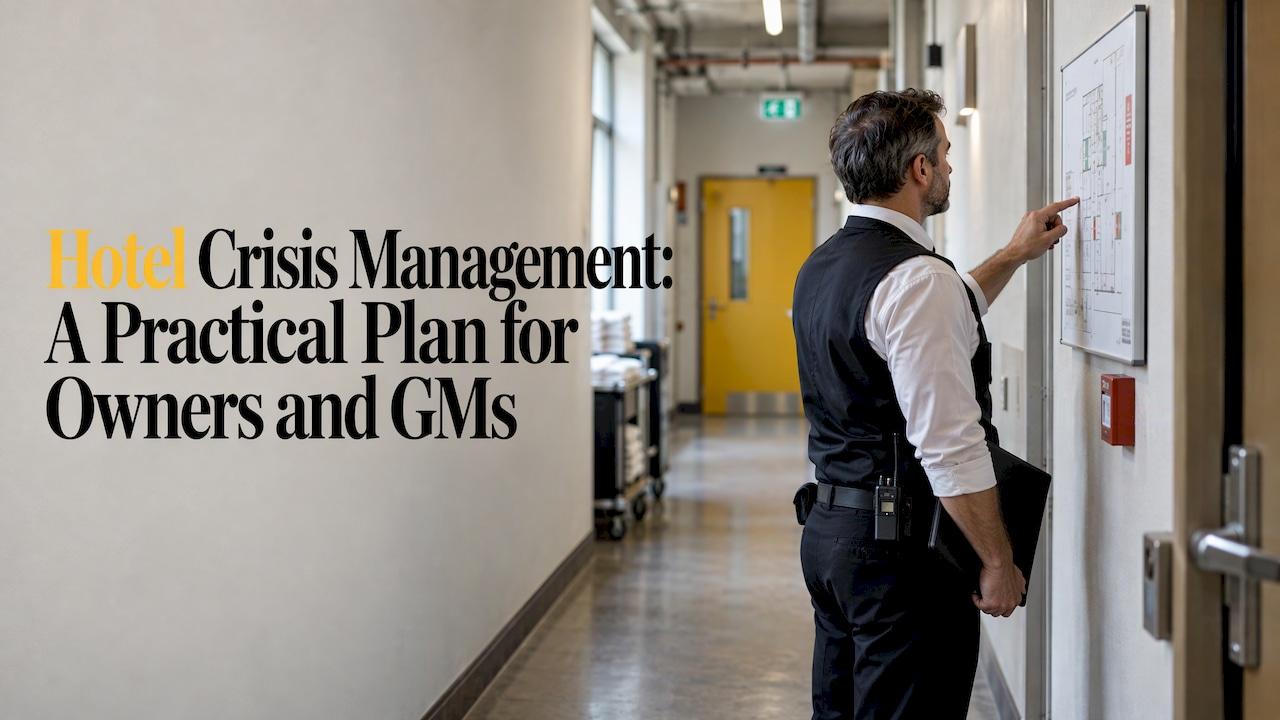
Hotel crisis management is the set of decisions, roles and routines that protect guests, staff and revenue when something goes wrong, from a kitchen fire to a ransomware attack to a viral complaint. The hotels that handle these events well do three things: they plan before the event, they run one clear chain of command during it, and they treat recovery as part of the plan, not an afterthought. This guide walks through each step the way an owner or general manager would use it.
TL;DR
- Crisis management has three phases: prepare, respond, recover. Most of the work happens before anything goes wrong.
- Plan for the full range of risks: medical events, severe weather, fires and outages, cyber incidents, security threats, supply and staffing shocks, and reputational crises.
- Name a core team with a leader, a spokesperson and a log keeper, and give every key audience one primary point of contact.
- Speak from a single source, check facts before release, and say plainly when you do not yet know something.
- Recovery means restoring critical functions first, protecting cash flow, and writing down what you would change.
Table of Contents
- What hotel crisis management actually covers
- The emergencies a hotel should prepare for
- Build the plan: team, steps and contents
- The first hours: how to respond
- Communication with guests, staff, authorities and media
- Supporting staff and guests during and after a crisis
- Recovery and business continuity
- Our perspective
- Work with LDB Hospitality
- FAQ
- Sources
What hotel crisis management actually covers
A crisis is any event that threatens people's safety, the property or the brand's credibility and cannot be handled by normal daily routines. Crisis management is broader than an evacuation drill. It covers risk assessment, written protocols, training, communication, insurance, and the review you do afterward.
It helps to think in three phases:
- Preparation. Identify hazards, write the plan, assign roles, train and exercise.
- Response. Activate the team, protect life first, communicate, document every decision.
- Recovery. Restore critical operations, support people, reassure the market, and update the plan.
The Hyatt Regency Grand Cypress's published emergency response plan is a useful model of priorities. It lists its objectives as protecting guests' life and health, protecting everyone else, protecting critical facilities and operations, and protecting the property's credibility, in that order. People come first, then the building, then reputation.
The emergencies a hotel should prepare for
A hotel is a small city: people sleeping, eating, working and gathering under one roof, with kitchens, pools, elevators, payment systems and a public lobby. According to TrainingHotels.com, the risk list includes:
- Medical emergencies, such as guest injuries, heart attacks or disease outbreaks
- Natural disasters, such as earthquakes, hurricanes, floods or wildfires
- On-property incidents, such as fires, power failures or elevator malfunctions
- Cyber threats, such as data breaches or ransomware
- Active shooters, terrorist incidents and civil unrest
- Supply chain disruptions and sudden staff shortages
- Reputational crises driven by negative social media attention
You will not face all of these, and your location changes the weighting. A coastal property in Florida ranks hurricanes first. A downtown convention hotel may weigh security and civil unrest more heavily. A small independent hotel with a thin front desk team may find that a data breach or a mass staff no-show is its likeliest crisis.
Rank risks by likelihood and impact
A simple grid works. For each risk, score how likely it is in your market and how badly it would hurt people, property and revenue. Start detailed protocols with the high-impact items, then add the rest. A one-page protocol for ten scenarios beats a 200-page binder nobody opens.
Build the plan: team, steps and contents
Follow a recognized planning process
You do not need to invent a method. The Nevada Office of Emergency Management's 2025 resort hotel plan guide outlines six steps that any hotel can adapt:
- Form a collaborative planning team designated by leadership.
- Understand the situation with a threats and hazards assessment.
- Determine goals and objectives.
- Develop the plan by generating and evaluating response alternatives.
- Prepare, review and approve the plan.
- Implement and maintain it.
The guide is built around FEMA's CPG 101, which offers the overarching framework for risk-informed planning. FEMA also notes that planning should engage the private sector, because when incidents hit businesses they often interrupt key community lifelines. For a hotel, that means your plan should be connected to the fire department, local law enforcement and emergency management office, not written in isolation.
What the written plan should contain
The Nevada guide lists required contents for resort hotel plans that make a good checklist anywhere: a facility layout map, internal and external access routes, the location and inventory of emergency response equipment, the location of unusually hazardous substances, and the name and phone number of the emergency response coordinator and the person responsible for compliance. Add after-hours numbers, utility shutoff locations and a current list of in-house guests and staff on duty.

In Nevada specifically, NRS 463.790 requires resort hotels to adopt and maintain an emergency response plan and to file any new or revised plan within three days with the local fire department, the local law enforcement agency and the Office of Emergency Management. That is a Nevada rule, not a national one. Check your own state and local requirements, and ask your insurer and fire marshal what they expect.
For a general business baseline, Ready.gov says every business should have an emergency plan protecting employees, contractors and visitors. Its 10-step outline includes assessing resources, talking with public emergency services, determining applicable regulations, developing protective actions (evacuation, shelter, shelter-in-place, lockdown), writing hazard-specific procedures, training personnel and running exercises.
Scenario protocols and chain of command
TrainingHotels.com recommends scenario-specific protocols that cover communication, evacuation procedures, exits, meeting points, resource distribution and staff coordination, with a defined chain of command and primary and secondary contacts for each area. Practically, each scenario page should answer five questions:
- Who declares the incident and who takes command?
- What is the first action in the first five minutes?
- Who do we call, in what order?
- What do we tell guests and staff, and who says it?
- Who records what happened?
Who sits on the crisis team
The Handbook of Hospitality Operations and IT describes a good core team as including a team leader, an incident response specialist who links with emergency services, a legal representative, financial representatives, IT, human resources, operations and recovery specialists, a public affairs or public relations coordinator, and a log keeper. A 40-room independent will not have all of these as separate people, so assign each function to a named person and a named backup. One person can hold two roles, but every role needs an owner.
The Nevada guide adds that the plan should spell out the emergency responsibilities of the chief executive, the safety or emergency manager, the facilities manager, the director of security and all other staff. Write these as short role cards, one page each.
Use a shared command language
FEMA describes the National Incident Management System as a common approach with shared vocabulary, systems and processes, including the Incident Command System, emergency operations center structures and multiagency coordination groups. You do not need to run a full ICS structure, but borrowing its vocabulary helps when firefighters or police arrive and ask who is in charge. Have one person ready to brief them.
The first hours: how to respond
When an incident starts, your plan is only as good as the first ten minutes. A workable response sequence:
- Protect life. Evacuate, shelter or lock down according to the scenario protocol. Call emergency services first, then the general manager.
- Activate the crisis team. The team leader takes command and confirms who holds each role.
- Assess and contain. Facilities and security report what is known: scope, affected areas, hazards.
- Communicate. Brief staff first, then guests, then outside audiences, using approved wording.
- Document everything. The log keeper records times, decisions, calls and who made them. This record matters for insurance, legal review and your later debrief.
The Hyatt Regency Grand Cypress plan states that emergency communications and decision-making must be streamlined, with methods and information coming from a single source. Mixed messages from the front desk, the bar and the manager on duty do more damage than silence.
Train for this. Run a tabletop exercise at least once a year, with a different scenario each time, and include night and weekend shifts, since crises rarely wait for the full management team to be on site.
Communication with guests, staff, authorities and media
The Destinations International Crisis Communications Handbook offers guidance that translates well to hotels:
- Designate a primary contact and means of communication for each key audience.
- Identify spokespersons in advance, and make a spokesperson available to the media frequently.
- Check information before release.
- Coordinate statements with other organizations.
- Correct false or misleading information.
- Say when you do not know an answer and will provide it later.
That last point deserves emphasis. "We don't have that yet, and we'll update you at 4 p.m." builds more trust than a guess that turns out wrong.
Audience by audience
| Audience | What they need first | Who speaks | Channel |
|---|---|---|---|
| In-house guests | Safety instructions, what is happening, what to do | Duty manager or designated guest contact | In person, room phones, text, signage |
| Staff | Their role, safety, shift expectations | Department heads, HR lead | Radios, group messaging, briefings |
| Emergency services | Layout, hazards, guest and staff counts | Incident response specialist | In person at command point |
| Media | Verified facts, next update time | Designated spokesperson only | Statement, briefing |
| Future guests and bookers | Operating status, policies for changes | Communications lead | Website, booking channels, social |
Social media during an incident
The same handbook recommends that the communications team closely monitor social media, get the timing and content of its own posts right, and evaluate and pause scheduled programs if appropriate. A cheerful promotional post going out an hour after a serious incident is a common, avoidable error. Pause the content calendar, post a factual status update, and point people to your official page for current information.
For industry-level support, the American Hotel & Lodging Association says it works with government and relief organizations to coordinate disaster response and pass on advisories, and its Safe Stay initiative set industry expectations for hotel safety, security and health. For security risks, AHLA also published a CISA resource, Securing Public Gatherings, which helps hoteliers connect with local authorities, build incident response plans, train staff and report concerns.

Supporting staff and guests during and after a crisis
Safety comes first, but people remember how they were treated in the hours after. Practical steps that fit most hotels:
For guests
- Assign a staff member to check in on anyone with mobility, medical or language needs during an evacuation.
- Offer a quiet, staffed space with water, phone charging and information while the situation is resolved.
- Decide in advance who can authorize relocations, rebooking, refunds and comped services, so front desk agents are not improvising.
- Follow up after departure with a short, sincere message and a clear contact for questions or claims.
For employees
- Tell staff what is known before they hear it from the news.
- Pay attention to anyone who witnessed an injury or a threat. Give them time off the floor if needed, and connect them to your employee assistance program if you have one.
- Be clear about scheduling and pay when the property is closed or partially closed.
- Hold a short debrief within days, and listen. Front-line staff usually know where the plan broke down.
These are operating practices, not clinical advice. If an employee shows signs of serious distress after an event, direct them to a licensed mental health professional or your employee assistance provider.
Recovery and business continuity
The response ends when the danger is over. Recovery is where revenue is won or lost. HOTREC's Crisis Resilient Guidelines for the Hospitality Sector, a European document whose principles apply broadly, describe resilience as the ability to withstand and recover while putting guest and staff safety first, and call it a dynamic process rather than a fixed state.
Their business continuity recommendations translate into a clear checklist:
- Write a business continuity plan with protocols for continuing or recovering critical functions.
- Identify critical functions and the maximum disruption you can tolerate for each: reservations, check-in, payments, housekeeping, food service.
- Keep a reserve fund for repairs.
- Line up backup suppliers.
- Build redundant power and data, with off-site data backup.
Protect the balance sheet
Insurance is part of recovery planning, not separate from it. Review your property, liability and business interruption coverage each year against your risk ranking, and confirm what triggers a claim and what documentation the insurer needs, which is one more reason to keep a good incident log. For a sense of how multi-risk business insurance packages cover fire, water damage, liability and lost income, see this multi-risk business insurance example from the hospitality sector.
Learn from it
Within two weeks, run an after-action review with the crisis team:
- What happened, minute by minute, from the log?
- What worked?
- Where did roles, equipment or communication fail?
- What are the three changes, who owns them and by when?
Then update the plan and retrain. A plan that is not revised after an incident is a plan that will repeat it.
Our perspective
Most hotels we speak with have a binder. Fewer have a plan their night auditor can actually follow at 2 a.m.
We see crisis readiness as an operations question and a guest experience question at the same time. The hotels that recover fastest tend to know their numbers: which functions bring in revenue, which guest segments are most exposed, and what guests said about the property before anything went wrong. That is why our approach starts with data, meaning market trends and customer feedback, and builds strategies tailored to the property instead of a generic template.
A crisis also tests your reputation. Guest feedback, review patterns and your communication habits are assets you build in calm periods. When something happens, they decide whether guests give you the benefit of the doubt. We help hotel and restaurant owners strengthen operational efficiency and guest experience so that the property is more resilient when pressure comes.
Our advice: assign names to roles this week, rank your risks by likelihood and impact, and schedule your first tabletop exercise. Then look at the whole operation, from staffing to guest communication, with someone who can measure what is working.
La’Quentin
Work with LDB Hospitality
If you own or invest in a hotel or restaurant and want your operations, guest communication and marketing to hold up under pressure, we can help. Our consulting combines strategic advice, operational support and performance optimization, built on market analysis and customer feedback. See our hospitality marketing strategies to learn how we work.

Ready to talk through your property's needs? Book a consultation and tell us where you want to improve.
FAQ
What is the first step in creating a hotel crisis management plan?
Form a planning team and assess your threats and hazards. The Nevada emergency management guide begins with a collaborative planning team designated by leadership, followed by a threats and hazards assessment. From there you set goals, draft protocols and review them with local emergency services.
Who should be on a hotel's crisis management team?
At minimum: a team leader, an emergency services liaison, legal, finance, IT, HR, operations, a communications lead and a log keeper. Small hotels can combine roles, but each function needs a named owner and a backup. Include night and weekend managers, since incidents often happen outside office hours.
How often should a hotel test its crisis plan?
Exercise it at least once a year, and again after major changes in staff, building layout or services. Ready.gov includes training personnel and facilitating exercises in its emergency plan steps. Vary the scenario and the shift so you test different people and conditions.
Are hotels legally required to have an emergency plan?
It depends on the state and the property. Nevada law requires resort hotels to maintain and file an emergency response plan. Other states and localities have their own fire, safety and licensing rules. Ask your local fire marshal and insurer what applies to you, and have counsel confirm your obligations.
What should a hotel say to the media during a crisis?
Speak through one designated spokesperson, share only verified facts, and say when you do not yet have an answer and when you will update. Coordinate with emergency services before releasing details, and correct false information promptly.
Sources
- Crisis Preparedness: Emergency Response Strategies for Hotels, TrainingHotels.com
- Nevada Resort Hotel Emergency Response Plan Guide, Nevada OEM
- Developing and Maintaining Emergency Operations Plans, FEMA CPG 101
- Emergency Response Plan, Ready.gov
- Hyatt Regency Grand Cypress Emergency Response Plan
- Crisis Management, Handbook of Hospitality Operations and IT
- Crisis Communications Handbook, Destinations International
- Emergency Planning and Preparedness, AHLA
- Safe Stay, AHLA
- Securing Public Gatherings, AHLA
- Crisis Resilient Guidelines for the Hospitality Sector, HOTREC
- Multi-risk business insurance for hotels and restaurants