
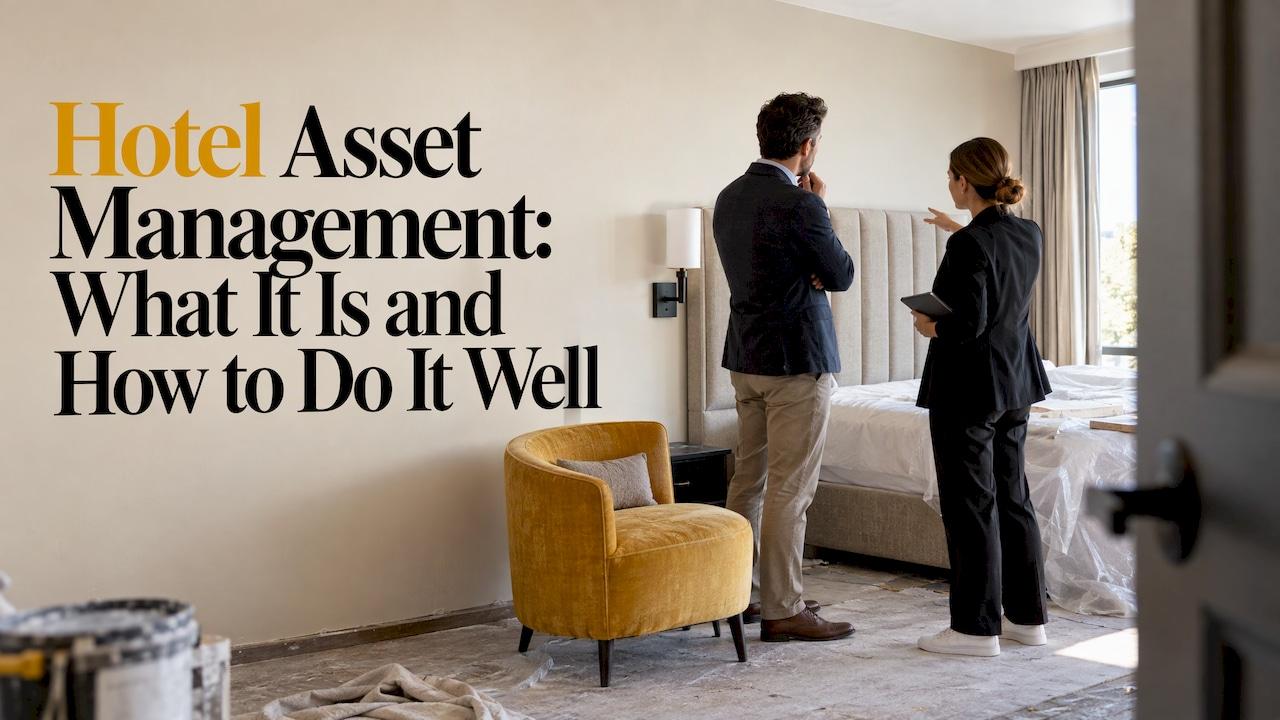
Hotel asset management is the owner-level discipline of protecting and growing the value of a hotel as an investment. The asset manager acts as the owner's proxy: they oversee the operator and the brand, challenge budgets, steer capital spending and advise on when to refinance, renovate or sell. Day-to-day operations belong to the management company. Asset management asks whether those operations are producing the return the owner expected.
This guide covers what the role involves, how it differs from hotel management, what a hotel asset management plan should contain, which strategies move revenue, cost and guest experience, and how to review results every quarter.
TL;DR
- Hotel asset management is ownership-level oversight. It protects the investment, while the operator runs the property day to day.
- A good plan ties every decision to the owner's goals: hold period, return targets, capital budget and exit timing.
- The core strategies are revenue and distribution discipline, cost control against benchmarks, planned capital spending and brand and operator accountability.
- Track results in the industry's standard reporting language. The 12th edition of USALI has been the adopted standard since January 1, 2026.
- Review the plan on a fixed rhythm: monthly numbers, quarterly strategy, annual budget and hold-or-sell decision.
Table of Contents
- What hotel asset management actually is
- What a hotel asset manager does for the owner
- What a hotel asset management plan should include
- Hotel asset management strategies that move the numbers
- Metrics that show whether asset management is working
- Putting the plan into practice: a 90-day rollout
- Our perspective
- How LDB Hospitality can help
- FAQ
- Sources
What hotel asset management actually is
A hotel is two things at once: an operating business and a piece of real estate. The operating business has staff, guests, rates and a nightly inventory that expires unsold. The real estate has a basis, debt, a renovation cycle and, eventually, a buyer. Hotel asset management sits where those two meet and answers one question for the owner: is this asset performing as capital?
In practice, the asset manager protects the owner's investment by working with the management company and the franchise brand. Industry asset managers interviewed by CoStar describe the job as aligning the interests of ownership, operator and brand, reviewing property and operator performance, and helping set strategy that is consistent with what ownership wants. Those three parties rarely want the same thing. The brand wants system fees and standards compliance. The operator wants to keep its contract and often earns on revenue. The owner wants net cash flow and a higher exit value. Someone has to sit in the middle, and that is the asset manager.
Asset management versus hotel management
The cleanest way to separate the two is by time horizon and by who the work serves.
| Hotel management | Hotel asset management | |
|---|---|---|
| Main question | How do we run the property well today? | How do we maximize the investment over the ownership period? |
| Focus | Staffing, guest experience, revenue management, maintenance | Financial performance, capital allocation, operator accountability, exit timing |
| Time horizon | Daily to annual | Entire hold period, typically several years |
| Serves | Guests and the property's operation | The owner and the lender or investors |
| Key output | Departmental results, guest scores | Owner returns, asset value, strategy decisions |
One is not a substitute for the other. An excellent operator with no owner-level oversight can drift toward goals that favor its own fees. An asset manager without a competent operator has nothing to steer. Owners who get the best results treat them as two layers of the same structure.
What a hotel asset manager does for the owner
The role varies by owner type. A family owning one select-service hotel needs something different from an institutional fund with twenty assets. The core responsibilities, though, are consistent.
Financial oversight. Reviewing monthly and quarterly statements, revenue trends, departmental profit, operating margins and budget variances. The goal is not to produce reports. It is to spot the line that is drifting before it becomes a lost year.
Budget challenge. Operators propose annual budgets. The asset manager tests the assumptions: Is the occupancy forecast realistic for the market? Are wage and benefit lines in step with local labor conditions? Is marketing spend producing bookings or just activity?
Business plan execution. Every hotel has a plan, whether written down or not. The asset manager checks that the operator is actually executing it: the sales strategy, the pricing approach, the renovation schedule.
Capital decisions. Furniture, fixtures and equipment reserves, brand-mandated renovations, repositioning, refinancing and sale timing all change long-term value. The asset manager reviews capital plans and advises the owner before money is committed.
Brand and operator accountability. Checking fees, performance tests in the management agreement, franchise compliance and the real cost of brand programs against what they deliver.
Exit planning. Knowing, well before a sale, what a buyer will scrutinize, and shaping the property's performance record and condition to match.
For investors, this is why asset management is part of due diligence and not an afterthought. For a single-property owner, it is often the difference between receiving statements and understanding them.
What a hotel asset management plan should include
Searchers also look for a "hotel asset management plan." The plan is the written document that turns ownership goals into measurable operating targets. Academic treatments of the process, such as Cornell's asset management course, frame it this way: evaluate the property by how it contributes to the owner's overall investment strategy and goals, and assess its strengths and weaknesses from the asset manager's perspective.
A workable plan has eight parts.
- Ownership objectives. Target return, hold period, risk tolerance, distribution expectations and exit window. Everything else refers back to this section.
- Property and market assessment. Position against the competitive set, demand generators, supply pipeline, physical condition and brand standing. Be honest about the weak spots.
- Financial baseline. Trailing twelve-month results by department, margins, debt service coverage and the variance against last year's budget.
- Strategy by revenue source. Transient, group, corporate, leisure and food and beverage, each with a target mix and the channels used to reach it.
- Cost and staffing plan. Where costs are fixed, where they flex with occupancy, and which lines will be benchmarked.
- Capital plan. Reserve contributions, brand-required work, return-on-investment projects, timing and funding source.
- Operator and brand scorecard. The performance tests, fee structures and service commitments you will hold each party to.
- Review calendar. Who reports what, how often, and what triggers a corrective conversation.
Keep it short enough that the owner actually reads it. Twelve to twenty pages with a one-page dashboard is usually better than a binder nobody opens.
Hotel asset management strategies that move the numbers
Strategy is where asset management becomes tangible. These are the levers that most often separate a hotel that holds value from one that slips.
Protect revenue after acquisition costs
Top-line revenue can look healthy while profit quietly erodes. Distribution costs are the reason. The American Hotel & Lodging Association's marketplace study defines Revenue Capture as the share of guest-paid revenue a hotel keeps after all customer acquisition costs, and calls it imperative to sustaining profitability. It found that acquisition costs were eroding profit contribution and asset values over 2014 to 2016, and estimated that every tenth of a point drop in Revenue Capture cut total U.S. industry asset value by about $1.8 billion. That data is a few years old, but the mechanism is the same today: what you pay to get the guest matters as much as the rate they pay.
For an owner, the practical moves are:
- Ask the operator for revenue by channel, net of commission and fees, not just gross.
- Track the direct booking share and set a target for it.
- Review brand-program and third-party costs against the incremental business they produce.
- Make sure the website, email and local marketing are built to win the direct guest. This is the territory of hospitality marketing, where data on guest behavior decides where spend goes.
Run revenue management as a discipline, not a setting
Review rate and occupancy against the competitive set monthly. Look at index performance (how the hotel's occupancy, rate and RevPAR compare with its set) and ask why when it moves. A hotel that gains occupancy by discounting has not necessarily gained anything. Look at the mix: weekday corporate, weekend leisure, group blocks and local demand each carry different cost and risk.
Control costs against benchmarks
Asset managers review expenses, departmental results, operating margins and budget variances, then press the operator for explanations where numbers sit outside expectations. Useful comparisons include cost per occupied room, payroll as a percentage of revenue, energy per available room and food and beverage cost of sales.
Do not forget the unglamorous lines. Supplies for food and beverage outlets and take-away service add up, and owners who check them against outside references tend to find something. A hospitality packaging price index is the kind of reference worth consulting when you test whether purchasing prices for disposables and service supplies are reasonable.
Plan capital instead of reacting to it
Deferred maintenance is borrowed money. The asset manager reviews capital expenditure planning and advises on projects that change long-term value: a guestroom renovation timed before a brand deadline, an energy retrofit that reduces operating cost, a lobby redesign that supports a rate premium. A good capital plan sequences work to protect revenue during construction and ties each project to an expected return.
Hold the operator and the brand accountable
Read the management agreement for performance tests, key-person clauses, reporting duties and termination rights. Compare actual fees and brand charges to what you were told at signing. The 12th revised edition of USALI added schedules for annual mandatory brand and operator costs, which makes these charges easier to see in standard reporting.
Invest in the guest experience where it pays back
Guest experience is not separate from asset value. Review scores, repeat stays and direct bookings all feed pricing power. Read the actual comments, sort them by theme, and fix the recurring ones first: noise, cleanliness, slow check-in, breakfast quality. Small operational fixes usually beat large capital projects in payback speed.
Metrics that show whether asset management is working
Reports are only useful if everyone reads them the same way. The lodging industry's common language is the Uniform System of Accounts for the Lodging Industry. Its 12th revised edition, published by HFTP, AHLA and the Hotel Association's partners, took effect on January 1, 2026, and is described as the authoritative worldwide standard for lodging financial and operating reporting. It also introduced new schedules for payroll full-time equivalents, which is helpful when you are testing staffing productivity.
What the owner should see every month:
| Metric | What it tells you |
|---|---|
| Occupancy, ADR, RevPAR and index vs. competitive set | Whether the hotel is winning or losing share |
| Revenue by channel, net of acquisition cost | How much of each booking you keep |
| GOP and GOPPAR | Operating profit before ownership costs, per available room |
| EBITDA and flow-through | How much of each added revenue dollar reaches the bottom line |
| Payroll and FTEs per occupied room | Labor productivity |
| Budget variance by department | Where the operator's forecast was wrong, and why |
| Guest review score and repeat rate | The health of demand over time |
| FF&E reserve balance and capital spent vs. plan | Whether the building is being protected |
The ratios matter less than the questions they trigger. If GOP is flat while revenue grows, ask where the flow-through went. If RevPAR index falls while the market rises, ask what competitors did that you did not.
Putting the plan into practice: a 90-day rollout
Plans fail in execution, not drafting. This sequence works for most owners, whether the plan is built internally or with outside help.
Days 1 to 30: baseline. Collect the management agreement, franchise agreement, last two years of financials, budgets, capital reserve history, STR-style competitive reports and guest reviews. Meet the general manager and the operator's regional lead. Write down the ownership objectives in plain numbers and get every owner or partner to sign off on them.
Days 31 to 60: diagnose. Compare each department to budget, prior year and benchmarks. Map revenue by channel and net it of cost. Walk the property with a critical eye, room by room, back of house included. List the five largest gaps between where the hotel is and where the objectives say it should be.
Days 61 to 90: commit. Convert the gaps into a plan: specific initiatives, owners, deadlines and expected financial effect. Agree on the reporting package and the review calendar. Attach the initiatives to the next annual budget so they are funded.

Reviewing results
Use a fixed rhythm so reviews do not depend on a crisis.
- Monthly: a one-page dashboard and a call with the operator on variances.
- Quarterly: strategy review. Are the initiatives delivering? Is the market moving? Does the capital plan still make sense?
- Annually: budget approval, capital plan refresh, operator scorecard and a formal hold, reposition or sell decision.
Write down what you expected each initiative to produce. When the quarter closes, compare actual with expected. Initiatives that miss twice are fixed or stopped.
Our perspective
Most hotels we see do not have a talent problem. They have an alignment problem. The owner thinks in returns, the operator thinks in occupancy, and the guest thinks in how the stay felt. When nobody connects those three views, money leaks in places that never show up as one big line item.
We start with data: market trends, channel mix and what guests actually say in their feedback. From there we build a strategy that fits the property in front of us, whether that is a boutique hotel or an upscale restaurant, and not a template. The aim is measurable improvement in occupancy, retention and profitability, and we want the owner to be able to see where each gain came from.
We also believe marketing belongs in the asset conversation. How a property wins its guests, and what it costs to win them, decides how much of every revenue dollar the owner keeps. Treat it as a capital-protection issue and not a branding exercise, and the strategy gets sharper.
La’Quentin
How LDB Hospitality can help
If your hotel or restaurant needs a clearer view of what is driving performance, we start with a conversation about your goals, your numbers and your guests. Our work combines strategic consulting, operational support, market analysis and customer feedback evaluation, built around a data-driven approach to guest experience and revenue growth. You can see how we approach hospitality marketing strategies on our site.

Ready to talk through your property? Book a consultation and bring your latest financial statements and guest reviews.
FAQ
What is the difference between a hotel asset manager and a hotel management company?
The management company runs the hotel day to day: staffing, guest service, revenue management and maintenance. The asset manager works for the owner and checks that those operations serve the owner's investment goals. One executes, the other oversees.
When does a hotel owner need an asset manager?
Usually when the owner is not an operator, holds more than one property, has investors or lenders to report to, or sees results diverging from the budget without clear explanations. Owners also add the role ahead of a major renovation, refinancing or sale, since those decisions change long-term value.
What should a hotel asset management plan cover?
It should cover ownership objectives, a market and property assessment, a financial baseline, revenue and cost strategies, a capital plan, an operator and brand scorecard and a review calendar. Every section should connect back to the owner's return and exit targets.
How often should an owner review hotel performance?
Look at a dashboard monthly, hold a strategy review each quarter and make budget, capital and hold-or-sell decisions annually. Fixed intervals keep problems from surfacing only when the year-end numbers arrive.
Which metrics matter most?
Start with RevPAR and index versus the competitive set, revenue net of acquisition costs, GOP and GOPPAR, flow-through, labor productivity and budget variance. Report them in line with USALI so every party reads them the same way.